About Cibotium menziesii Hook.
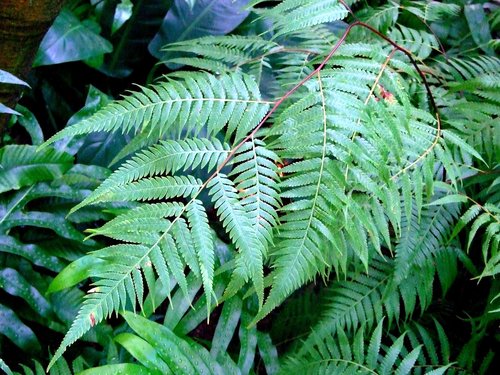
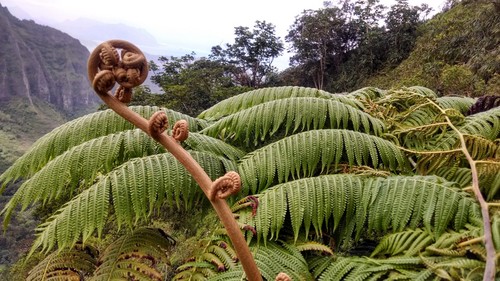
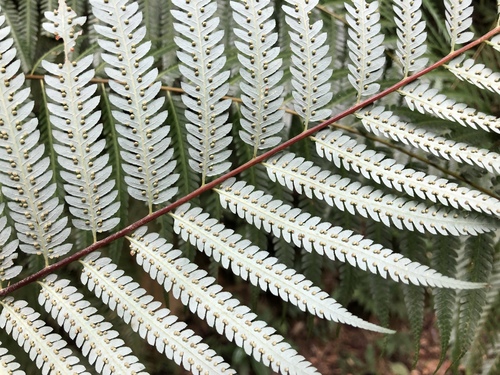
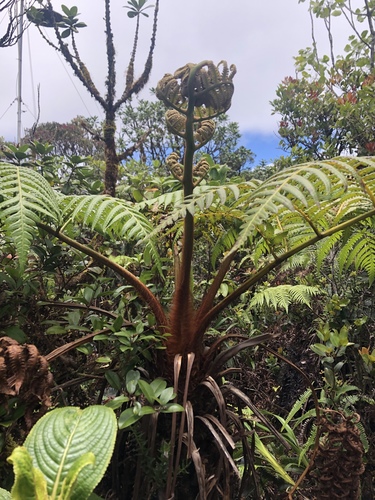
Cibotium menziesii Hook., commonly called hāpuʻu ʻiʻi or Hawaiian tree fern, is a tree fern species in the family Cybotiaceae that is endemic to the Hawaiian Islands. It is named for Scottish naturalist Archibald Menzies. It is also referred to as the male tree fern, while Cibotium glaucum is considered the female tree fern, due to their differing coloration. This species is endemic to the windward regions of the main Hawaiian Islands. It grows in rainforests at elevations ranging from 305 to 1,830 m (1,001 to 6,004 ft), and can grow either on the ground or as an epiphyte on trees. Although it is native to Hawaii, it is highly adaptable, can tolerate long cool winters, and requires only a small amount of heat to stimulate new growth even when it has lost all its fronds. Currently, populations of this species are declining, due to impacts from invasive species (especially feral pigs) and commercial harvesting. Cibotium menziesii reproduces naturally via spores, which develop at the ends of its fronds and are released from these positions. For domestic and commercial propagation, spores are collected from the plant's lower fronds, then heated, treated with water, and stored under refrigeration. Side shoots growing from the main trunk are also able to grow into new plants, but must be cut close to the trunk to be viable. The starchy core of the trunk can be cooked, most often stewed, and eaten; this core was a staple food for people during periods of famine. It is also an important food source for feral pigs. In traditional medicine, the pith of hāpuʻu ʻiʻi is combined with ʻolena (Curcuma longa) roots, pawale (Rumex giganteus), and ʻokolehao liquor to make a 'blood purifier'. A treatment for chest pain is made from hāpuʻu ʻiʻi and ʻamaʻumaʻu (Sadleria cyatheoides) piths, kukui (Aleurites moluccana) bark, ʻohiʻa ʻai (Syzygium malaccense) bark, ʻahakea (Bobea spp.) bark, ʻuhaloa (Waltheria indica) root bark, popolo (Solanum americanum), ʻaukoʻi (Senna occidentalis), noni (Morinda citrifolia) fruit, and ko kea (Saccharum officinarum). Heated fibres from the fronds are used to treat a range of common bodily ailments including muscle pain and joint stiffness. The frond fibres, called pulu, are used to absorb bodily fluid from corpses in preparation for traditional burials. These same fibres are also used to make handcrafted pillows that are sold as tourist souvenirs in Hawaii. Native Hawaiians traditionally hollowed out the trunk of this fern to use as a planter for uhi (Dioscorea alata), and this practice is still followed today.