About Ciboria rufofusca (O.Weberb.) Sacc.
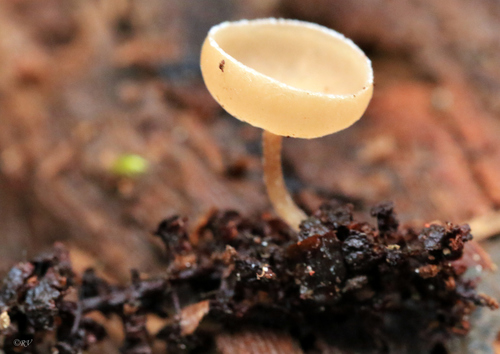
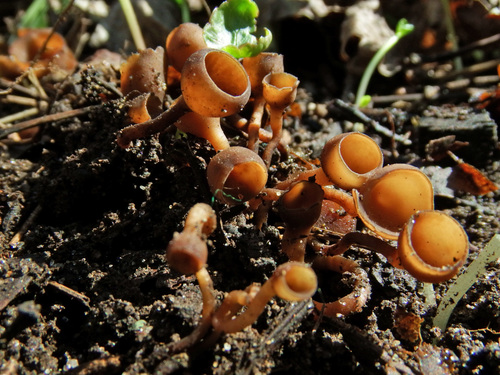
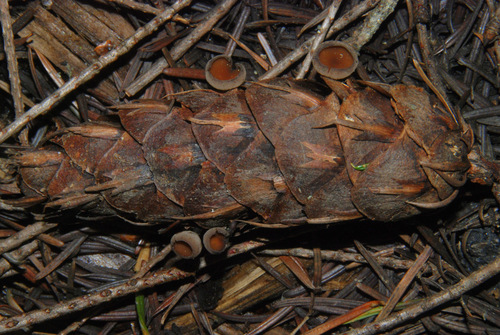
Ciboria rufofusca is an ascomycete fungus that produces distinctive cup-shaped fruiting bodies called apothecia. When young, these apothecia are cup-shaped and blister-like (vesicular), and can grow up to 15 mm in diameter. Each fruiting body is held up by a dark brown to blackish stipe, which connects directly to its substrate, which is most often conifer cone scales. The stipe is usually short, but can reach up to 10 mm long when it grows from buried cone scales. The edge of the cup (margin) starts out smooth and entire, but becomes incised as the fungus matures, gradually spreading out to develop an undulating, lobed-incurved shape. The spore-bearing hymenium on the inner cup surface is smooth, and ranges in color from uniform brown to maroon. The outer surface of the cup (the excipulum) is paler than the hymenium, and has a furfuraceous texture, which is scurfy or bran-like. Under the microscope, the spores of Ciboria rufofusca are oval, smooth, and transparent (hyaline), measuring 5.0–7.3 × 3.0–3.5 micrometres. Spores typically hold one or two small oil droplets (guttules) at each end. The spore-containing asci are cylindrical, measuring 75–110 × 5.5–6.0 micrometres, and each ascus holds eight spores arranged in a single uniseriate row. The apex of the ascus shows a weak but distinct blue color change when stained with iodine. The sterile paraphyses filaments that grow between asci are non-septate (lack cross-walls), slender, only barely swollen at their tips, and measure 70–75 μm in length. The outer tissue layer (excipulum) ends in distinctive pear-shaped (piriform) cells. Ciboria rufofusca grows exclusively on fallen conifer cone scales, with a primary association with Abies alba, the silver fir. It has also been recorded on cone scales from other Abies species, multiple Picea (spruce) species, and occasionally on Pseudotsuga menziesii, the Douglas fir. In the Pacific Northwest of North America, it grows on fallen fir cones. This species is considered rare across most of Western Europe, except for mountainous regions. It is relatively common in the Jura Mountains and Vosges Mountains, where silver fir grows in abundance. Distribution records document the species in Germany's Eifel region and in Luxembourg's Little Switzerland region. In Belgium, the species is extremely rare. Its distribution there is limited by its preference for Abies alba, which is not native to Belgium and is only planted as an ornamental tree in parks and gardens. Before Mertens' 2008 discovery of the species in Walloon Brabant, only one other potential collection had been reported in Belgium: a find from Huizingen growing on Douglas fir cone scales in May 2001, though this specimen was not preserved. The species has also been collected just 12 km from the Belgian border, in the French Ardennes. Its fruiting bodies typically appear in early spring, from March to May, growing on humid soil where cone scales have fallen.