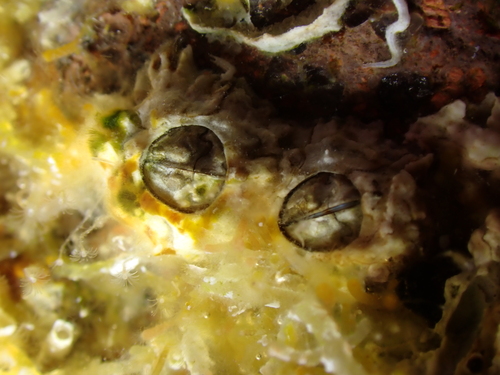
About Chthamalus stellatus (Poli, 1791)
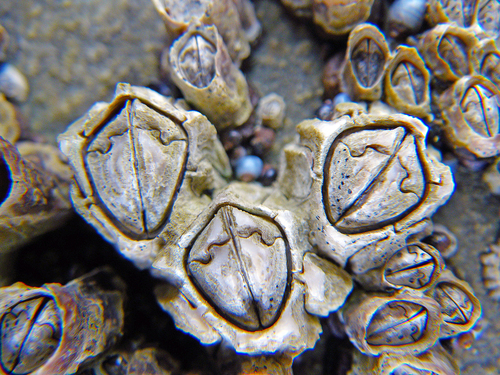
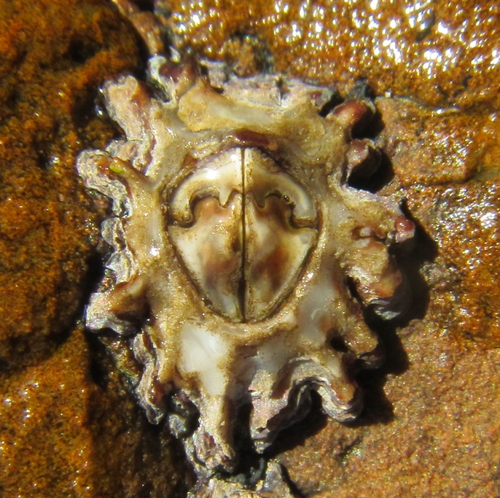
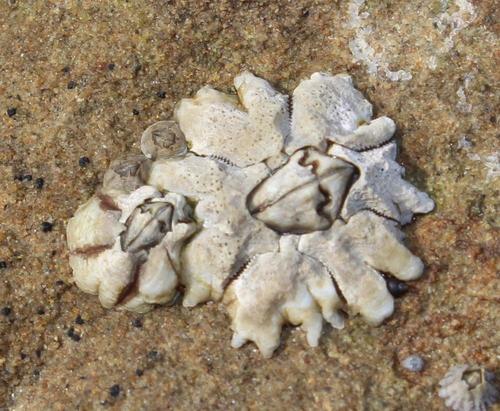
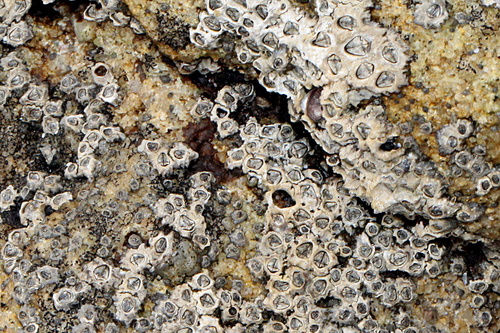
Chthamalus stellatus (Poli, 1791) is a sessile barnacle that uses its membranous base to attach to rocks and other firm materials in the intertidal zone. It is generally cone-shaped, but can grow into a more tubular shape when part of a crowded colony. Like all other sessile barnacles, adult C. stellatus is a suspension feeder that remains fixed inside its shell. It uses feathery, rhythmically beating modified legs to pull plankton and detritus into its shell to eat. The chalky white shell of C. stellatus has a kite-shaped opercular opening when the barnacle is juvenile, and an oval opercular opening when it is fully grown. The shell is constructed from six solid wall plates of roughly equal size. The species' relatively narrow rostral plates stay separate from its rostrolateral plates and do not fuse together. When the opercular aperture is not tightly closed, bright blue tissue marked with black and orange is visible. Depending on environmental conditions and food availability, C. stellatus can grow to a maximum diameter of 14 millimetres (0.55 in). C. stellatus attaches to exposed rocky shores in the mid to low eulittoral zone of the northeastern Atlantic Ocean. It prefers islands and headlands over bays and more protected areas. Though it is a southern warm-water species, it has been found as far north as Shetland and as far east as the Isle of Wight. A 2021 examination of specimens collected from the Cape Verde Islands found that while these individuals were morphologically similar to C. stellatus, their genetic differences from C. stellatus were larger than those observed between other distinct Chthamalus species. This may justify classifying these Cape Verde populations as an evolutionarily significant unit and a sister clade to C. stellatus. The vertical distribution of C. stellatus overlaps with that of Chthamalus montagui (which was considered the same species as C. stellatus until 1976) and Semibalanus balanoides. The higher prevalence of one species over another in a given location may be linked to differences in the distribution of the species' larval stages. Like most barnacles, C. stellatus is hermaphroditic and can self-fertilize when isolated. However, individuals typically take on either a male or female role for mating. Functional males that are permanently fixed have penises significantly longer than their bodies, which they use to search the surrounding area for a stationary neighboring functional female to fertilize. When functioning as a female, individuals of this species produce between 1,000 and 4,000 eggs per brood. Fertilized eggs stay inside the adult's shell until they hatch into nauplii, free-swimming larvae that float along with other plankton in ocean currents. After several molts, the larvae metamorphose into cyprids, a non-feeding life stage. Cyprids swim to search for a suitable hard surface, then attach head-first to the surface and metamorphose into the well-known hard-shelled, immobile adult form. The length of the breeding season for C. stellatus can depend on temperature, and the species produces fewer broods near the northern limit of its range.