About Chrysuronia oenone (R.Lesson, 1832)
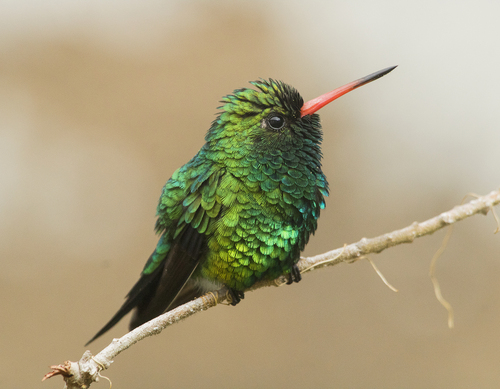
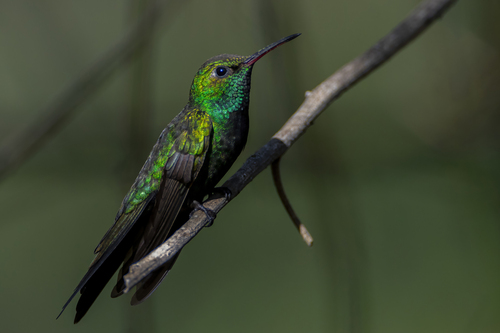
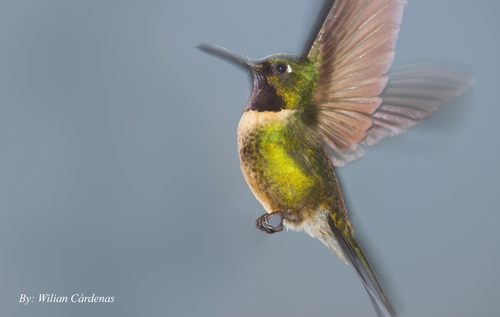
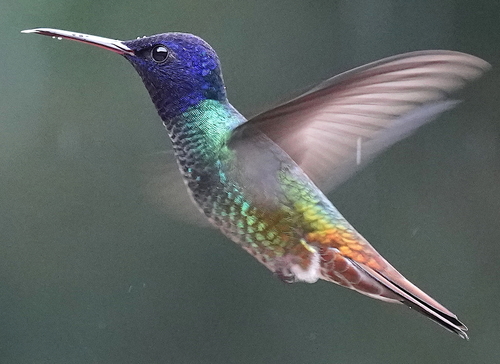
The golden-tailed sapphire, scientifically named Chrysuronia oenone (R.Lesson, 1832), measures 9.5 to 10 cm (3.7 to 3.9 in) in total length. Males weigh between 4.7 and 6.3 g (0.17 to 0.22 oz), while females weigh 4.3 to 5.3 g (0.15 to 0.19 oz). For all subspecies, both sexes have a slightly curved bill: the maxilla is black, and the mandible is red with a black tip. Adult males of the nominate subspecies have a violet-blue head and throat. Their back is bright green, transitioning through bronze-green to bright coppery wing coverts and a copper-bronze tail. Their breast is glittering green, their belly is bronze-green, and the undertail coverts are bronze with whitish edges. Adult females have a blue crown, green back, copper-bronze wing coverts, and copper-bronze tail. Most of their undersides are whitish, with blue-green flecks on the sides of the throat and neck, green coloration on the sides and chest, and bronze-green flanks. Their undertail coverts are bronze. Juvenile males have a dull green crown, dusky gray throat, and dull green chest. Early adult feathers that grow in on their head and throat are a purer blue with less violet tint than those of fully mature adults. Juvenile females have duller, more bronze-colored throat speckles than adult females. When subspecies C. o. josephinae and C. o. alleni are treated as separate taxa, both differ from the nominate subspecies and from each other. Males of C. o. josephinae have a mostly green throat and a green rump that contrasts with the coppery wing coverts. C. o. alleni has an entirely green throat, very little blue on the cheeks, and a coppery rump.
The nominate subspecies of golden-tailed sapphire has the widest distribution. It occurs in Serranía del Perijá, which spans the border between Colombia and Venezuela, extends further east into western and northern Venezuela, and runs south through east-central Colombia, eastern Ecuador, and extreme western Brazil to reach extreme northeastern Peru. Strictly defined C. o. josephinae is found across most of the remaining eastern part of Peru. C. o. alleni occurs in northern Bolivia. The golden-tailed sapphire lives in semi-open landscapes, including edges and gaps within humid forest, mature secondary forest, gallery forest, shady cacao and coffee plantations, and gardens. Its elevation range is from sea level to 1,500 m (4,900 ft) in Colombia and Venezuela, and between 400 and 1,200 m (1,300 and 3,900 ft) in Ecuador.