About Chrysuronia leucogaster (J.F.Gmelin, 1788)
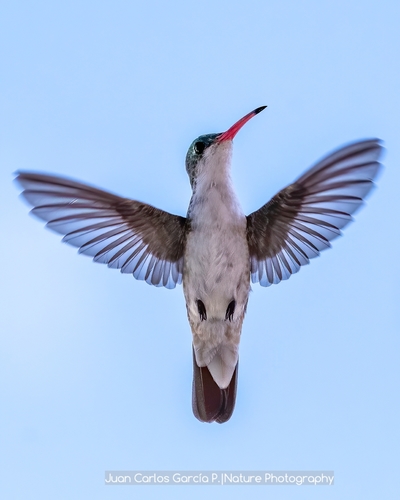
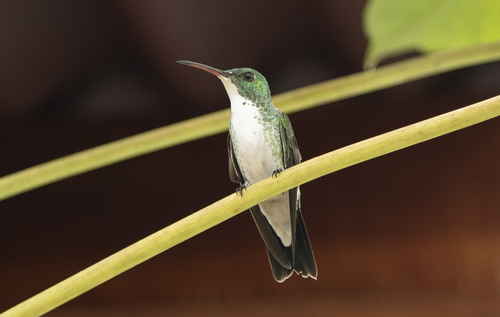
The plain-bellied emerald (scientific name Chrysuronia leucogaster, first described by J.F. Gmelin in 1788) measures 9 to 10 cm (3.5 to 3.9 in) in length. Males weigh 4 to 4.5 g (0.14 to 0.16 oz), while females weigh approximately 4.3 g (0.15 oz). Adult individuals have a short, straight to slightly decurved blackish bill, with a red base on the lower mandible.
Adult males of the nominate subspecies C. l. leucogaster have glittering green crowns and neck sides. The rest of their upperparts, flanks, and throat sides range from golden-green to bronze-green. The center of the throat and all underparts are white. Their inner tail feathers are bronze-green to bronze, and the outer tail feathers are bluish black. Adult females are similar to males, but have greenish spots on the throat sides and grayish green tips on the tail feathers. Immature birds look similar to adult females, and also have brownish edges on their back feathers. The subspecies C. l. bahiae is very similar to the nominate subspecies, but is less bronze in coloration.
The two subspecies of plain-bellied emerald have separate disjunct coastal distributions. The nominate subspecies occurs from northeastern Venezuela through Guyana, Suriname, and French Guiana into northeastern Brazil, reaching as far south as Piauí state. C. l. bahiae occurs in eastern Brazil, ranging from Pernambuco south through Alagoas, Sergipe, and Bahia, and extends slightly into Espírito Santo. This species lives in a variety of semi-open to open landscapes, including mangroves, mature forest edges, secondary forest, cerrado, caatinga, and human-created areas such as plantations, parks, and gardens. It occurs mostly near sea level, but reaches elevations as high as 250 m (800 ft) in Venezuela.