About Chrysuronia brevirostris (R.Lesson, 1829)
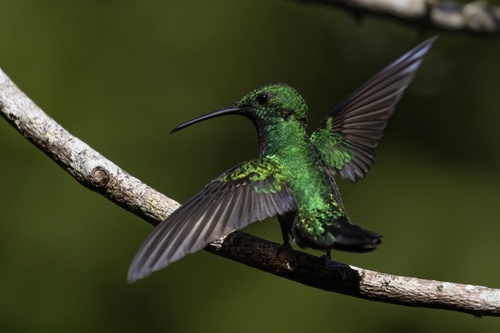
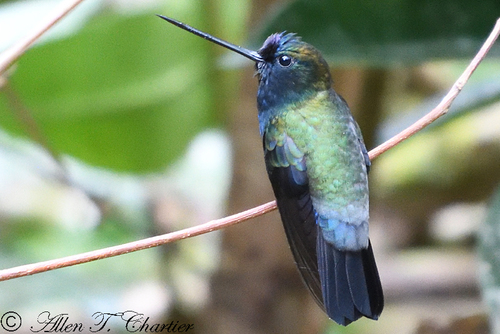
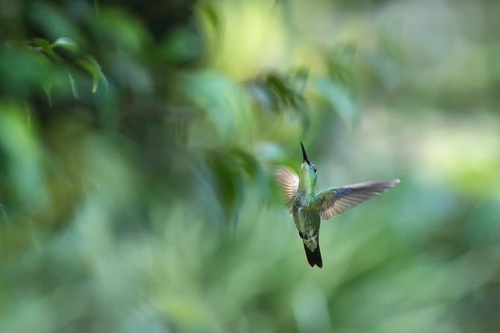
The white-chested emerald (Chrysuronia brevirostris) measures 9 to 10 cm (3.5 to 3.9 in) in total length. Males weigh approximately 4.6 g (0.16 oz), while females weigh around 4.4 g (0.16 oz). For all subspecies, adults of both sexes share a short, straight, blackish bill, and the plumage of the two sexes is almost identical. The nominate subspecies has iridescent turquoise-green crown and cheeks, and shining bronze-green upperparts that fade to a coppery tone on the rump. Its central tail feathers are coppery, and the outer tail feathers range from bronze to copperish, with blackish bars near the end of their underside. The underside from throat to belly is white, with bronze-green coloring on the sides and flanks. The undertail coverts are golden-green with white edges. Females differ from males only by having grayish tips on their outer tail feathers. Juveniles have similar plumage to adult females, and have a yellowish to reddish base to their mandible. Subspecies C. b. chionopectus is noticeably larger than the other two subspecies, but shares the same plumage pattern as the nominate. C. b. orienticola is similar to the nominate, but has darker, more bronze-colored upperparts and flanks. Among the three subspecies of the white-chested emerald, the nominate subspecies has the widest distribution. It occurs in eastern Venezuela, Guyana, Suriname, and extreme northern Brazil's Roraima state. C. b. chionopectus is found only on Trinidad, and C. b. orienticola occurs only in coastal French Guiana. The species as a whole lives in a wide range of landscapes, including rainforest, semi-deciduous forest, gallery forest, secondary forest, scrublands, savanna, and some cultivated areas. C. b. chionopectus prefers more open landscapes, including cacao plantations. Very few specimens or sightings of C. b. orienticola exist, and all recorded occurrences are from coastal areas.