About Chrysotoxum pubescens Loew, 1864
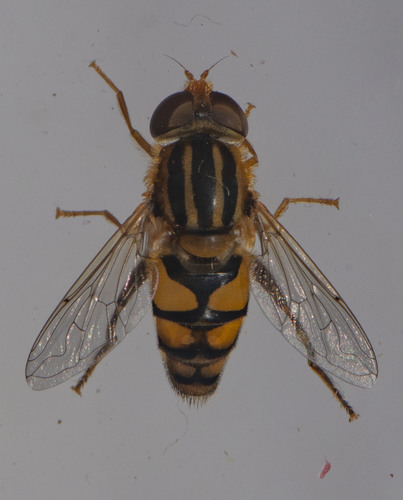
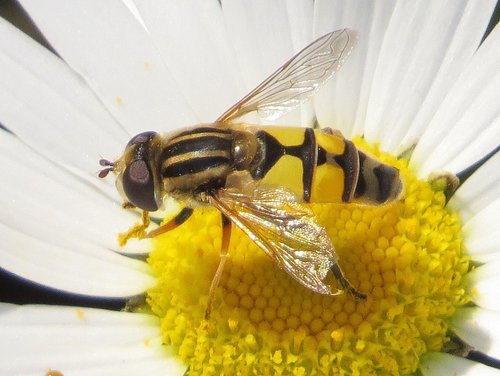
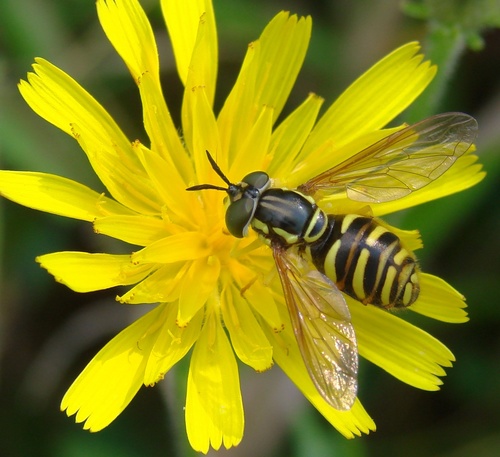
For terminology used in this description, refer to Speight's key to genera and associated glossary. Adults measure 1.5 mm (0.06 in) in length. The antennae are shiny black: the second segment is longer than the first, and the third segment is approximately equal in length to the first two segments combined. The eyes are covered with fine hairs; females have widely separated eyes, while males have holoptic (touching) eyes. The face is yellow with a black median stripe, and a black stripe along the lower eye margin separates the face from the gena. The underside of the cheeks has extensive pale yellow coloration, which the common name Yellow-throated Meadow Fly references. The frons is black and covered with long yellow hair; females have a yellow pile spot on each side above the antenna base. The lateral stripes of the thorax are interrupted, and the median vittulae are distinctly whitish and pollinose. The proepimeron (located above the front coxa) is yellow, a feature also referenced in the common name Yellow-throated Meadow Fly. The scutum is black, covered with sparse, long yellow hair that is longer on females. Two distinct longitudinal grayish pile stripes run down the middle, one on each side of the center; these stripes may be faint or absent in males. A slightly interrupted, wide yellow stripe runs along the lateral edges of the scutum. The scutellum is yellow with a black center. The thorax pleura has a large yellow patch, with a smaller pale yellow spot below the large patch that sometimes touches it, a second small spot near the head opposite the large patch, and two additional small spots on each side of the wing base. The first abdominal segment is black; all remaining abdominal segments are covered with sparse, erect yellow hair. Arched yellow stripes start at the lower outer edge of each segment, curving toward the segment base near the center, and are interrupted at the center. A slightly paler yellow stripe runs along the lower margin of each segment; this stripe is thicker at the center, and its thickness increases progressively on each subsequent segment. A small reddish-orange blotch sits on the lower edge of each segment, where the stripe originates directly below the base of the previous segment. The fifth abdominal segment has an elongated yellow triangular spot on its hind margin, with a black inverted V or Y-shaped marking between this spot and the thick yellow fascia. The abdominal venter is black. Wing vein R4+5 shows a clear dip into cell R4+5. The outer edge and base of the wing are slightly tinted, with a light brownish-yellow color. The basal cell (bm) is completely covered with pile, and the halteres are reddish-yellow. All legs are yellow. The hind half of the hind femur is reddish-yellow, and the tarsi are also reddish-yellow. This species occurs in Canada and the United States; a distribution map is available for reference.