About Chrysosplenium iowense Rydb.
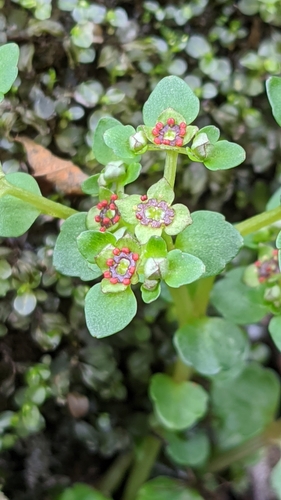
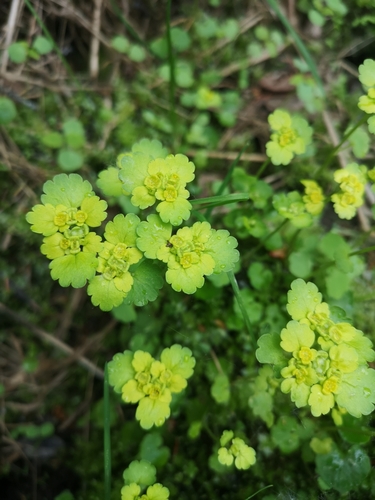
Chrysosplenium iowense Rydb. is a small, easily overlooked plant with upright, hairless stems. It is stoloniferous, producing thin stolons, and stems grow up to 15 centimeters tall. Flowering stems do not develop during the plant’s first growing season. Leaves grow on both the stolons and the stems. On stems, leaves are arranged alternately; lower leaves are roundish with seven to eleven lobes, and the top two leaves are adnate (joined) to the branches of the inflorescence. The inflorescence is a cyme holding up to 12 flowers, with leaf-like yellow-green bracts and small yellow or greenish sepals. The flowers have yellow anthers. Flower production varies with temperature, with maximum flowering occurring when the substrate is around 11 to 12 °C. Insects are required for pollination of this species. Its cuplike fruit capsule holds many reddish seeds. Populations of Chrysosplenium iowense are generally small, holding no more than a few hundred individuals. The species grows in wet and moist streambanks and woods. As a northern species, it occurs and persists in constantly cool to cold spots in the southern part of its range, such as ice caves and tunnels that carry cold air. In the United States, it occurs on algific (cold-producing) talus slopes derived from dolomite, where cold air seeps downward from ice caves on north-facing slopes. These cool moist habitats are very limited in size; some are only one square meter. Other species restricted to these relic boreal locations include Carex media, Adoxa moschatellina, and several endemic land snails. Recorded associated plant species are Abies balsamea, Acer spicatum, Adoxa moschatellina, Betula alleghaniensis, Carex peckii, Circaea alpina, Cornus canadensis, Equisetum scirpoides, Linnaea borealis, Lycopodium spp., Maianthemum canadense, Mertensia paniculata, Rhamnus alnifolia, Ribes hudsonianum, Taxus canadensis, Trillium nivale, and Viburnum trilobum. United States populations of Chrysosplenium iowense are likely relicts of Pleistocene flora that survived glaciation, and now persist in boreal microhabitats. It is listed as an endangered species in Minnesota, and a threatened species in Iowa. Threats to the species include trampling and other human and cattle-caused disturbance. Logging is a threat for multiple reasons: logging machinery damages habitat, and logging activity leads to succession of woody vegetation, erosion, and changes to shade levels and hydrology. Agriculture also alters its habitat. In Alberta, the plant grows in areas with active oil and gas exploration. Some sources classify this species as C. alternifolium var. sibiricum.