About Chrysoperla carnea (Stephens, 1836)
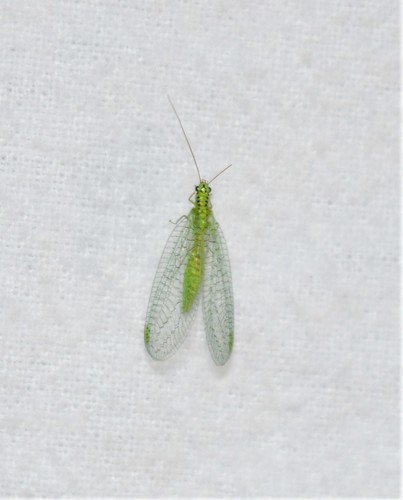
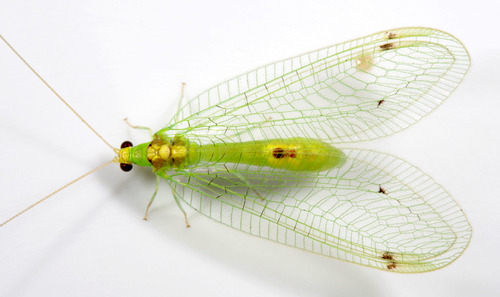
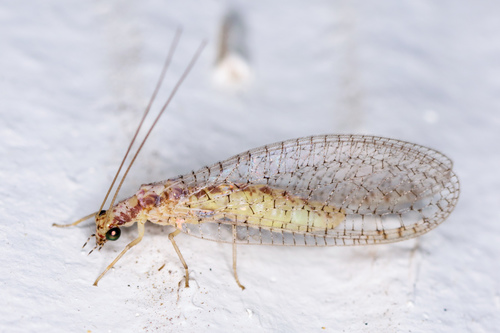
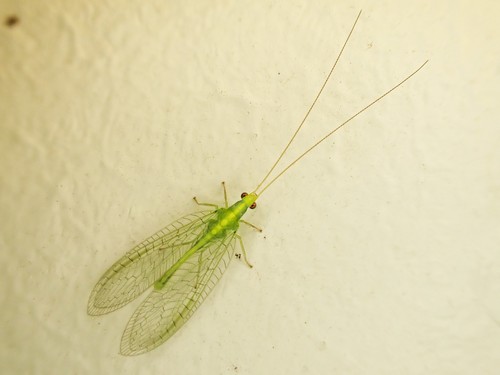
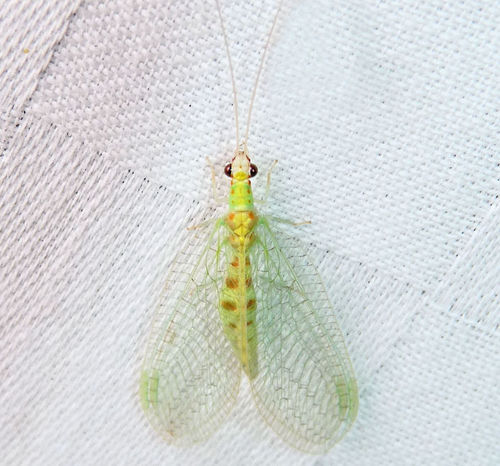
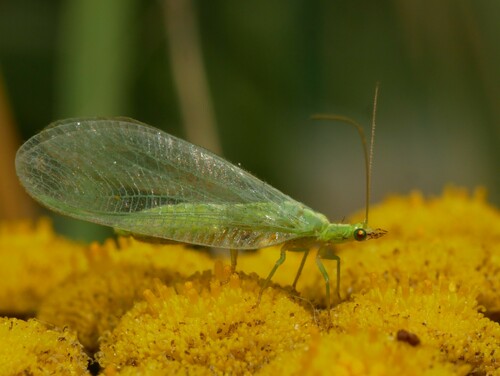
Chrysoperla carnea, the common green lacewing, has distinct life stage characteristics. Its eggs are oval, pale green when first laid, turning gray later, and each is anchored to a plant by a long, slender stalk. Newly hatched larvae are about 1 millimetre long, brown, and resemble small alligators, crawling actively to hunt for prey. Their heads have a pair of pincer-like mandibles to grasp prey, sometimes lifting prey off leaf surfaces to stop escape. Larvae inject digestive enzymes into prey bodies to break down internal organs, then suck out the liquefied body fluids. Before pupation, larvae grow to about 8 millimetres long, then spin circular cocoons to pupate. Adult green lacewings are pale green, 12 to 20 millimetres long, with long, threadlike antennae and glossy golden compound eyes. They have a delicate appearance, with large membranous pale green wings that they fold tent-like over their abdomens. They are weak fliers with a fluttery flight, and are most active in the evening and at night, where they are often attracted to lights. The high green sensitivity of their superposition eyes lets them recognize fresh green leaves, which they use to locate aphid-produced honeydew, find egg-laying sites, and choose resting spots.
This species was originally classified as an exclusively European species. However, ongoing taxonomic revisions to the genus Chrysoperla, especially the Chrysoperla carnea species group, mean the exact geographic range of the species is still uncertain. As of 2009, two primary candidates for true C. carnea are recognized: Cc2 (nicknamed "slow motorboat") and Cc4 (nicknamed "motorboat"). Cc2 has the more restricted range of the two, extending from central Spain north to England and east to Greece and Hungary. Cc4 is more widespread, ranging north from the Southern Alps through the United Kingdom into southern Fennoscandia, and east to western or central Russia. The two candidates also differ in habitat preferences: Cc2 is restricted to warmer elevations below 1,000 meters, while Cc4 is more cold-tolerant and occurs at elevations above 1,000 meters.
Adult green lacewings overwinter buried in leaf litter at field edges or other uncultivated rough sites, and emerge when spring weather warms. Each female lacewing lays several hundred eggs, at a rate of 2 to 5 eggs per day. Females choose concealed spots under leaves or on shoots near potential prey, and normally lay eggs during dark hours. Eggs hatch 3 to 6 days after being laid. Newly emerged larvae eat voraciously and moult three times as they grow. They feed on aphids as well as many other insect types, and will even prey on larger creatures like caterpillars. They can consume large numbers of prey, and can completely eliminate entire aphid colonies. When food is scarce, larvae become cannibalistic and eat each other. After 2 to 3 weeks, mature larvae secrete silk to build round, parchment-like cocoons in concealed locations on plants. Adults emerge from these cocoons 11 to 13 days later. The total length of the life cycle is less than 4 weeks under summer conditions, and is strongly affected by temperature. Multiple generations can occur each year under favourable conditions.