About Chrysopelea ornata (Shaw, 1802)
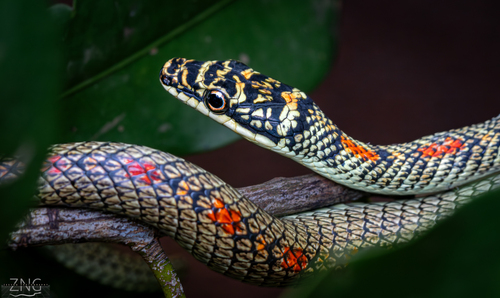
Chrysopelea ornata (Shaw, 1802) is usually green, with black cross-hatching and yellow or gold accents. Its body is slender, but much less slender than the bodies of other tree snakes. It has a flattened head, a constricted neck, a blunt nose, and large eyes with round pupils. This species can be distinguished by the lateral, sharp, pronounced keeled structure of its ventrals, paired with a normal, non-enlarged vertebral row of scales. Total body length ranges from 11.5 to 130 cm (0.38 to 4.27 ft). Individuals reach maturity at around 1 m (3.3 ft) in total length, and the tail makes up about one-quarter of the total body length. Chrysopelea ornata has two main color forms, described below. In Sri Lanka and the southern part of its Indian range, the snake is primarily greenish yellow or pale green. Each scale has a black central streak or spot, and is more or less edged with black. The snake also has dark crossbars at intervals. A series of large, flower-shaped, reddish or orange vertebral spots may be either present or absent. The ventrals are greenish, and are edged with black or spotted outside the keel. The head is black with yellow crossbars and spots. Flower-shaped vertebral spots are more common in Sri Lankan populations than in south Indian populations. The second color variety, which is more common in Southeast Asia, lacks reddish vertebral spots and has less prominent black crossbars. All color varieties can be found across the entire distribution area of the species. This snake occurs in India (including North Bengal, the Western Ghats, the Dangs, Katernia Ghat in Uttar Pradesh, North Bihar, northern West Bengal, eastwards to Arunachal Pradesh, and the Andaman Islands forests), Bangladesh, Sri Lanka, Nepal, Myanmar, Thailand, Western Malaysia, Laos, Cambodia, Vietnam, China (Hong Kong, Hainan, Yunnan), and introduced populations are found in Singapore. Little is known about the breeding habits of Chrysopelea ornata. It is an oviparous species, and females lay 6 to 12 elongated eggs. Gravid females have been recorded in May and June, and hatchlings have been recorded in June. According to Smith, mating occurs in June in Bangkok. Hatchlings measure 114–152 mm (4 1⁄2 to 6 in) long, and the smallest recorded gravid female was 1,093 mm (3 ft 7 in) long.