About Chrysomya megacephala (Fabricius, 1794)
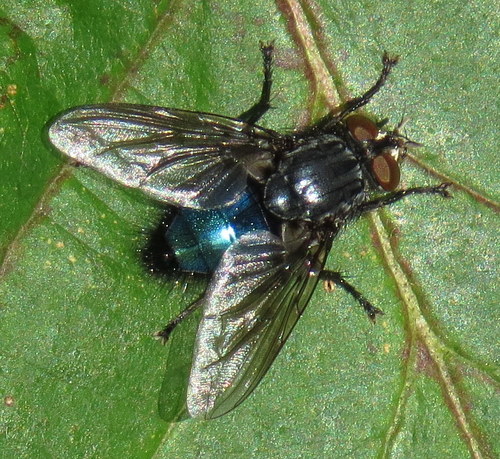
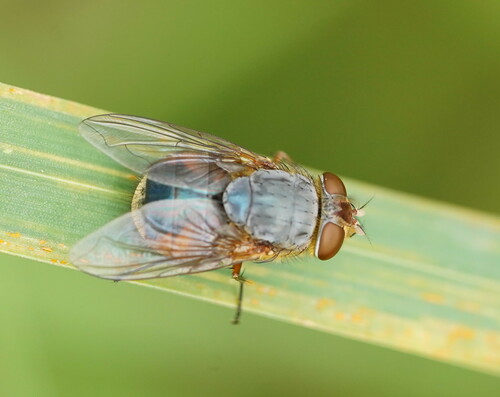
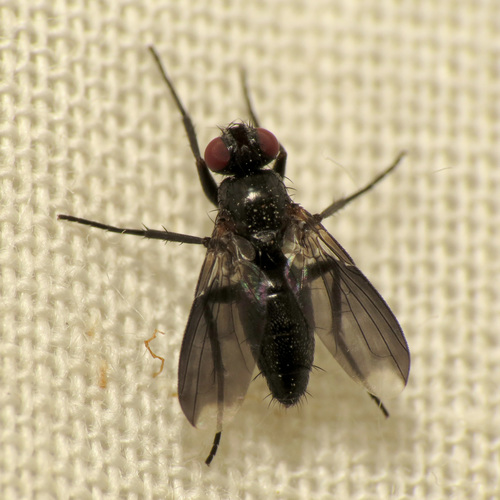
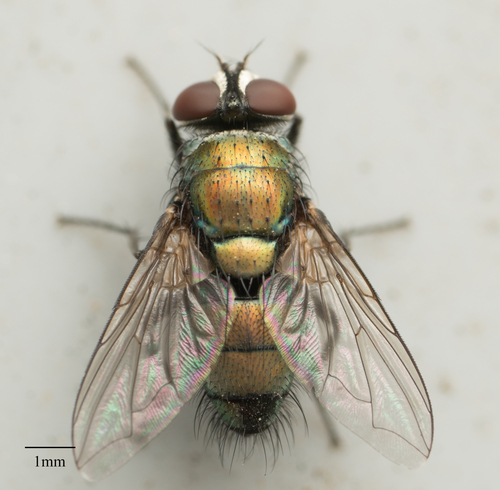
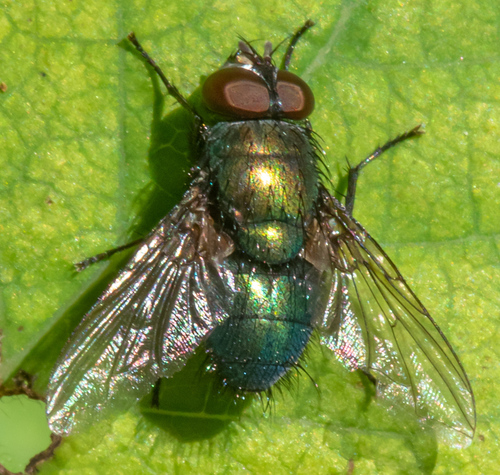
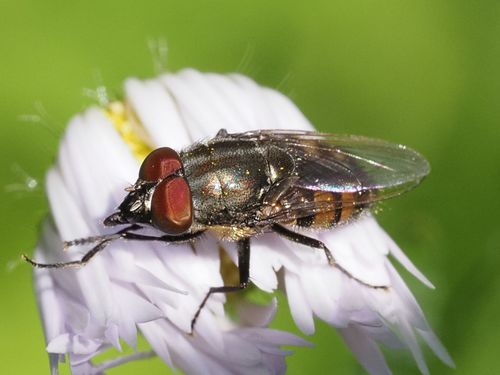
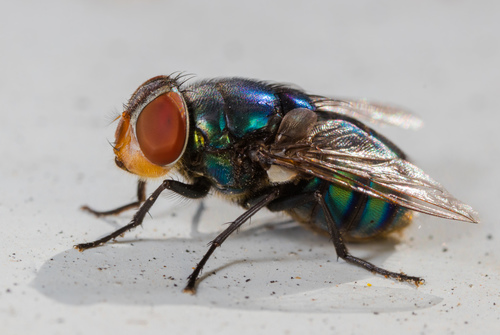
The eggs of Chrysomya megacephala are oval, with one flat face and one convex face. Adult flies have a metallic blue-green sheen on their thorax and abdomen, and yellow gena (cheeks). Larvae vary in size by instar, and their bodies taper toward the front, becoming thicker toward the rear. This species has large red eyes; male eyes are positioned close together, while female eyes are farther apart. The male cercus is longer than the female cercus.
Chrysomya megacephala has a broad geographic distribution. It is most common in the Oriental and Australasian realms, and is also found in Japan and the Palearctic realm. Since the 1970s, its range has expanded to include New Zealand, Africa, and South, Central, and North America. The species entered the United States through harbors and airports, and has been recorded in California, Texas, Louisiana, and Hawaii. There are two distinct forms of C. megacephala: the normal (plesiomorphic) form, which inhabits tropical forests on Pacific Islands such as Samoa, and the derived form, which is thought to have originated in Papua New Guinea and is synanthropic, meaning it is ecologically associated with humans.
The life cycle of C. megacephala consists of egg, larval, and pupal developmental stages. A female can lay up to 200 to 300 eggs at a time, most often in human feces, meat, or fish. Larval development includes three instars (growth periods). Overall, eggs take approximately one day to develop, larvae take 5.4 days, and pupae take 5.3 days. Population counts and adult body size are strongly influenced by temperature. The average adult lifespan of this fly is approximately seven days. Development rate depends on both larval feeding duration and temperature: lower temperatures lead to slower larval development. In laboratory studies conducted at 27 °C, eggs hatch after 18 hours, the first larval molt occurs after 30 hours, the second molt after 72 hours, pupation begins after 144 hours, and adults emerge after approximately 234 hours. These development intervals vary by geographic location, and other environmental factors can also affect how long larvae remain in the larval stage. Male adults typically emerge two to three hours earlier than female adults.
Reproduction and survival rates of C. megacephala are closely tied to developmental factors, including available food and competition from larvae of other species such as Chrysomya rufifacies. When competing larvae are present, C. megacephala larvae spend less time feeding, which leads to earlier pupation, smaller adult body size, and earlier reproduction. When feeding resources are limited or larval density is high, the second and third instar larvae of C. rufifacies act as predators that feed on C. megacephala larvae. In these conditions, C. megacephala larvae often disperse early and remain malnourished.
In regions where organophosphates are used, C. megacephala can be useful for detecting larval-state poisoning. Organophosphate compounds are highly toxic substances used in agriculture, and organophosphate poisoning often results in death. The toxin can usually be identified by testing a deceased person's body tissues and fluids, but this is challenging when the body is extremely decomposed. A medical examiner in Hawaii worked on a case where death was suspected to be caused by poisoning from malathion, an organophosphate insecticide. Malathion was detected in the victim's stomach contents and body fat. C. megacephala and C. rufifacies larvae were present on the victim's body, and testing found malathion in both species. Prior to this case, there was no recorded evidence of organophosphates accumulating in these fly larvae. This finding shows that studying larvae from heavily decomposed remains can be an effective method to detect the presence of these toxins in a severely decayed body.
Apart from its use in forensic investigations, Chrysomya megacephala has other practical beneficial uses. In the Australian region, this blowfly acts as a pollinator for mango crops. While most regions seek to eliminate C. megacephala populations, Taiwanese farmers have developed methods to increase populations of this blowfly to boost mango pollination.