About Chrysomma sinense (Gmelin, 1789)
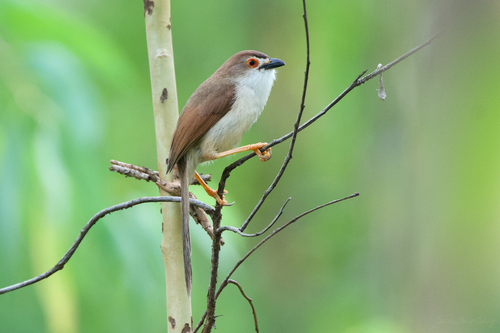
Chrysomma sinense, commonly called the yellow-eyed babbler, measures about 18 centimetres (7.1 in) long, with a short bill and a long graduated tail where central tail feathers are around twice as long as the outermost. The upper body is brown, and the wings are cinnamon-colored. Adults have white lores and supercilium, an orange-yellow eye rim, a black beak, and whitish buff underparts. The sexes cannot be distinguished from each other in the field. Across its wide distribution, there are plumage differences between populations that have been classified as subspecies. The nominate subspecies occurs in Burma, Laos and Thailand. The Sri Lankan subspecies nasale has black nostrils and a stouter bill. Subspecies hypoleucum, found across most of India, has yellow nostrils like the nominate subspecies and paler plumage. The population in India’s northeast Duars, which has an almost slaty crown and darker wings, was named saturatius or saturatior, but this is now considered clinal variation and included in the nominate population. The yellow-eyed babbler’s range spans from Pakistan through India, Nepal, and Sri Lanka, extending to Bangladesh, Myanmar, Thailand, Laos, Viet Nam and China. Its typical habitat is grassy or thorny scrub in both dry and wet regions, as well as farmland. It occurs mainly on plains, but can also be found in lower hills up to 1200 m. It is absent from the dense forest region of the Western Ghats, only occurring on the eastern edges or in gaps such as Palghat. Like other babblers, yellow-eyed babblers are usually seen in small groups of five to fifteen, particularly in the non-breeding season. They typically stay inside bushes, emerging to the top of a stem before diving back into cover to forage. They feed mainly on insects, but also consume berries from Lantana and Salvadora, as well as nectar. When capturing insects, they may hold prey down with their feet. Groups constantly make a series of cheeping or churring calls. During the breeding season, which falls mainly in the southwest monsoon from June to August, and sometimes during the receding monsoon, males produce a strong whistling twee-twee-ta-whit-chu song, often given from a prominent perch. The inside of the mouth is reported to change color from orange-brown to black during the breeding season. Yellow-eyed babblers appear to nest cooperatively. Their nest is a deep cone constructed from grass, lined with fine fibre, and wedged between upright stems, which are incorporated into the nest’s wall. The outside of the nest is heavily covered in cobwebs. Clutches typically contain four eggs, ranging from three to five in total. The eggs are pinkish white with chestnut-red patches. Both parents share incubation and feeding of the young. Eggs hatch after about 15–16 days, and young birds fledge after around 13 days. Adult birds have been observed feigning injury, likely to distract predators. The species roosts communally in the center of a bush, with all birds facing the same direction and sitting side by side. Group members will preen each other. During an apparent territorial display, one pair of birds has been observed singing while facing another singing pair; all pairs simultaneously bobbed their heads while perched with legs held straight to appear taller. Shikras have been recorded attempting to prey on yellow-eyed babblers. In parts of northern India, this species is known as gulab chashm, meaning "yellow spectacles", and was sometimes kept as a cagebird.