About Chrysolopus spectabilis (J.C.Fabricius, 1775)
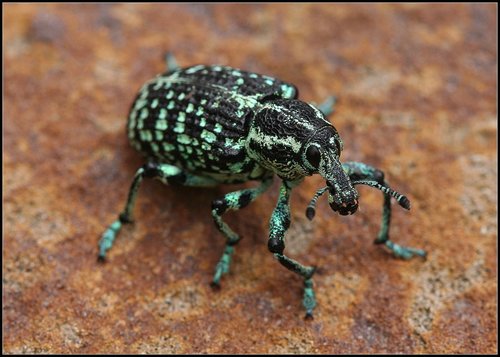
Chrysolopus spectabilis (J.C.Fabricius, 1775) has an elongated oval body 15–25 millimetres (0.6–1.0 in) long. Its elytra are black, marked with irregular spots of bright metallic green. The underside of the body is shaded matt green, and a white or green line runs along the full length of the beetle's sides. Its head, thorax, and legs are black, with occasional metallic green markings. The beetle's colouration changes throughout the year, with individuals emerging later in the season having a bluer hue. Its snout is about as long as the bell-shaped pronotum, and is strongly curved. Geniculate antennae grow from the midpoint of the snout, and end in a small club. The compound eyes protrude slightly. The elytra have a row of furrows with slight depressions, and the ventral side of the body is covered in scales. The beetle's powerful legs have a thick covering of hair on the tarsi, which lack claws. Mature larvae are 40–50 mm (1.6–2.0 in) long; they are white, round, and wrinkled, with a small number of hairs on their sides, and a red-brown head with black mandibles. As of current records, the pupa of this species has not been formally described. This species is found in eastern and southern states of Australia, with a range extending from coastal Queensland through Victoria to eastern parts of South Australia. It is most common in eastern New South Wales, particularly in areas surrounding Sydney, and extends out to the foothills of the Great Dividing Range. Adult beetles are active both day and night, mostly during the warmer months from November to March. During this active period, C. spectabilis is often found in built-up areas and woodlands in regions with moderate precipitation, especially around Acacia plants. In open areas like northern New South Wales, the beetle prefers Acacia species with phyllodia (flattened leaf petioles), while in more heavily wooded areas such as the Blue Mountains, it prefers species with paripinnate leaves. Adult beetles have been recorded on 28 of the 1000 Acacia species present in Australia, while larvae have only been recorded on seven species. Despite this difference in recorded hosts, larvae are thought to feed on the same Acacia species as adults. Development from egg to adult usually takes less than one year. Females bore up to 20 small, closely spaced holes into the stem of an Acacia plant just above soil level, and lay a single egg into each hole. After hatching, larvae bore deeper into one of the plant's main roots. Adults emerge in spring at more southerly latitudes, but can emerge year-round in subtropical parts of the species' range. After completing development, adults bore their way out of the plant, leaving the empty pupal case behind. C. spectabilis feeds almost exclusively on specific species of Acacia, including Cootamundra wattle (Acacia baileyana), silver wattle (Acacia dealbata), Australian blackwood (Acacia melanoxylon), and golden wattle (Acacia longifolia). The beetles select young plants around 50–150 cm (20–59 in) tall, before the plants have flowered. They use their long snout and powerful mouthparts to create holes in stems and leaves, to access sap and build egg chambers. In south-eastern Australia, C. spectabilis can act as a pest of acacia plantations. Adults can destroy new shoots, and larvae can reduce the plant's ability to take up water. Adults can even kill a tree through ring barking. Despite its bright, contrasting colouration, C. spectabilis is not poisonous. It is very alert, and if it detects danger it will either fall to the ground and play dead, or grip tightly to the plant with its legs.