About Chrysolophus amherstiae (Leadbeater, 1829)
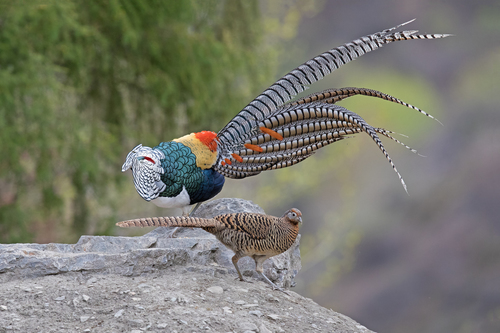
Adult male Lady Amherst's pheasant (Chrysolophus amherstiae) measure 100–120 cm (39.5–47 in) in total length, with the long tail making up 80 cm (31 in) of this total. Males are easily recognizable, with a white and black nuchal cape, a red crest, a long greyish-white tail marked with black bars and red streaks at the base, white chest and belly, scaled green throat, dark green back, blue and brown wings, and a yellow rump. The nuchal cape can be raised during courtship displays. This species is closely related to the golden pheasant (C. pictus), and is slightly larger; it has a yellow eye, surrounded by blue-green bare skin. The bill is horn-coloured, and the legs are blue-gray. Females are far less showy, with dull mottled brown plumage covering the entire body, similar to the plumage of female common pheasants (P. colchicus) but with finer barring. Females closely resemble female golden pheasants, but have a darker head and cleaner underparts than golden pheasant hens. Despite the male's bright, showy appearance, these birds are very hard to observe in their natural habitat, which consists of dense, dark forests with thick undergrowth. As a result, little is known about their wild behaviour. The species is native to southwestern China and far northern Myanmar, but has been introduced to other locations outside its native range. A self-sustaining feral population was previously established in England, with its main stronghold in West Bedfordshire. Lady Amherst first introduced this ornamental pheasant to her estates, near the Duke of Bedford's Woburn Abbey, where the birds were also shot for game and interbred with other species. While introduced British populations are thought to have become locally extinct since 2015, occasional sightings of the species have been recorded across the UK in the years since, most likely from birds that have escaped from private collections. During the time when Lady Amherst's pheasant populations were established in England, they were recorded to interbreed extensively with the larger introduced golden pheasant populations, and interbreed with common pheasants to a more limited degree. Most existing golden pheasant populations carry at least trace genetic ancestry from Lady Amherst's pheasants. Multiple factors contributed to the decline of the species in England: predation by the Eurasian goshawk, which was largely absent from the island when the pheasants were first introduced; destruction of woodland understorey caused by browsing from Reeves's muntjac, another introduced species; habitat loss from increased felling of hardwood forests, which were replaced with commercial softwood plantations that have no understorey, plus increased human recreational use of remaining woodlands; and loss of wildlife corridors that isolated remaining populations from one another.