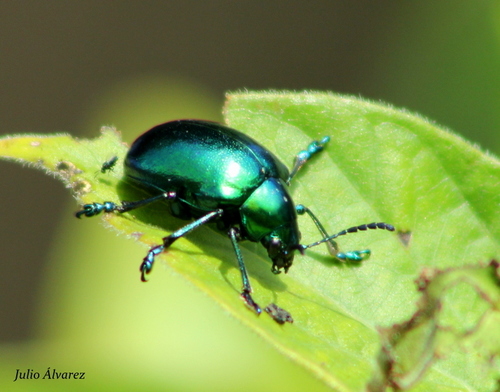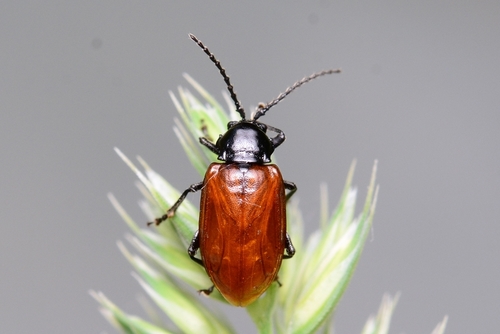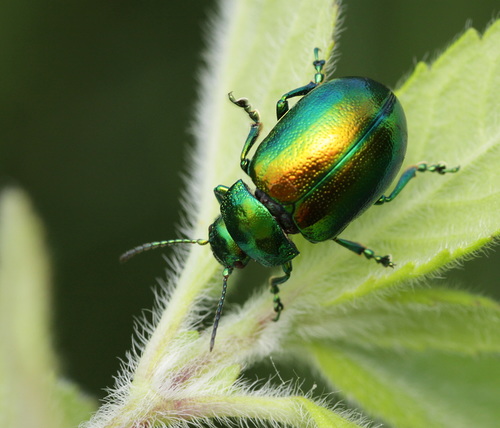
About Chrysolina graminis (Linnaeus, 1758)
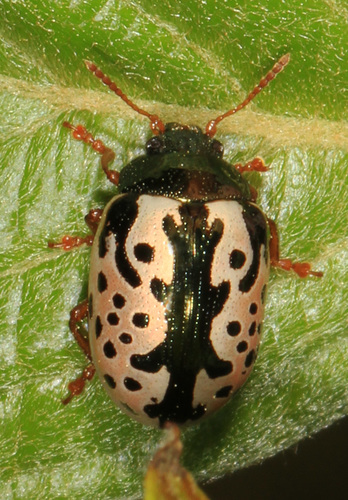
Chrysolina graminis, commonly known as the tansy beetle, is a small, rounded beetle measuring approximately 7–12 mm in length. There are six recognized subspecies, which differ from one another in both internal and external morphology. It has a Palearctic distribution; archaeological evidence confirms its presence in western Europe at least as early as the Neolithic period. In Britain, individuals can be found on tansy (Tanacetum vulgare) and water mint (Mentha aquatica) in fenlands and on the banks of broad floodplain rivers. Larvae have also been recorded on other host plants: Achillea ptarmica (sneezewort) in France, and various plants from the genus Artemisia in Russia. Both adults and larvae feed on the leaves of their host plants. Across continental Europe, C. graminis is widespread, ranging from Scandinavia down to the Mediterranean Sea. It also occurs in central Asia, China, and Russia, where it can be found in the tundra zone from the Polar Urals to the Kolyma River; it is additionally present in the nearby countries of Kazakhstan and Mongolia. It is listed as vulnerable in Austria, Denmark, Sweden, and Norway; in Germany, it is rare in one district and endangered in another. Declines in C. graminis populations are likely driven by habitat loss, caused by land improvement, conversion to arable land, over-grazing, development, drainage, and lowered water tables from over-abstraction. Habitat neglect can also lead to habitat loss or degradation, through processes like over-shading or competition between food plants and invasive species such as Himalayan balsam (Impatiens glandulifera). Flood-bank construction or maintenance work can deplete or destroy local subpopulations. Within the York (UK) distribution, C. graminis depends entirely on tansy as a food source. When a tansy clump disappears, beetles must walk to a new host location, as they rarely fly despite having fully functional, capable wings. Habitat loss reduces the species ability to find alternative host plants. Additionally, tansy is a ruderal species with a naturally high rate of plant turnover, which forces beetles to regularly search for new tansy patches to colonise. In 2009, a study of tansy beetle occupancy across 1305 tansy patches (defined as groups of stems separated by no more than 50 cm) on the banks of the River Ouse in York, UK, was conducted to collect data on tansy distribution and relate it to existing tansy beetle populations, to support conservation efforts for the species. Analysis of results using generalised additive models found that tansy patches should be managed to reach a volume of 3 m3, and these patches should be located within 200 m of existing beetle subpopulations on the same river bank to support beetle dispersal and population survival. Both adults and larvae use the same host plant throughout their life cycle. Since tansy typically grows in discrete clumps, the total C. graminis population in an area may be split into distinct groups, and individual beetles may complete their entire life cycle within an area of just a few square metres. Adults mate between March and June. In monitored populations at York, mating between a single pair can last over 24 hours, and some pairs move between different tansy patches during this period. In one Russian population of C. graminis, mating is preceded by an elaborate mating ritual not observed in other populations of the species: the male taps the female's eyes, pronotum, and antennae with his own antennae. After mating, females lay batches of 3–15 elongated, yellow eggs, each 2 mm long, on the undersides of tansy leaves. In captivity, one newly mated female produced 561 eggs over 136 days, while another produced 158 eggs over 49 days. Females lay eggs in multiple locations, and the average clutch size is 5–6 eggs. Female C. graminis will cannibalise eggs laid by other females. In laboratory conditions, newly hatched larvae can survive for at least four days without food, giving them an extended window of opportunity to reach a host tansy plant. In July, final instar larvae burrow underground beneath their host plant to pupate; very little is known about the biology of this pupal stage in C. graminis. The new adult generation emerges between August and September to feed, then returns underground to overwinter in October. Adults emerge again between March and April of the following year. Long-term monitoring shows that survival during winter hibernation is surprisingly high, as autumn and spring population sizes are very similar. This holds true even with annual winter flooding of the River Ouse, meaning overwintering individuals must be extremely tolerant of long periods of inundation and oxygen deprivation. Approximately 5% of overwintering adults do not emerge from the soil after winter, and instead remain underground for an additional year in a state of extended diapause, emerging the following spring. A small number of adults overlap between the spring and summer populations, but most adults from the earlier spring emergence die before the end of summer. Neither adult nor larval tansy beetles can detect their host plant, or other beetles, at a distance via smell, sight, or a combination of the two. Starvation is therefore likely a major cause of mortality when beetles wander away from their host and become lost.