About Chrysolepis sempervirens (Kellogg) Hjelmq.
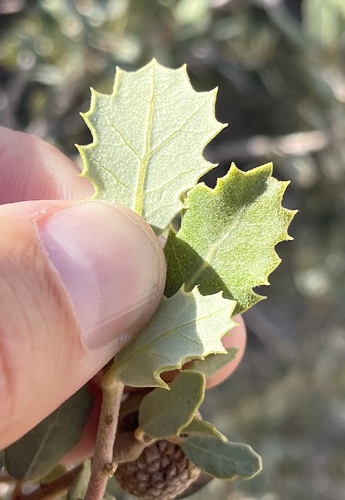
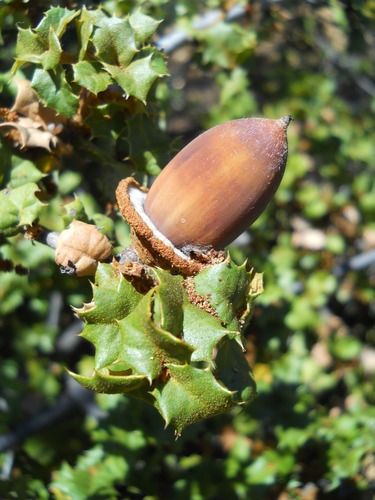
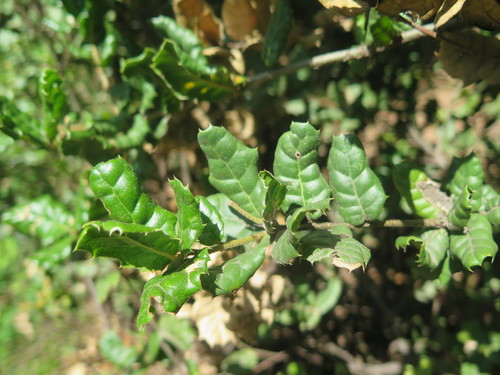
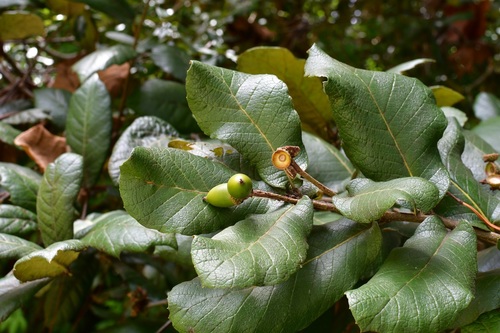
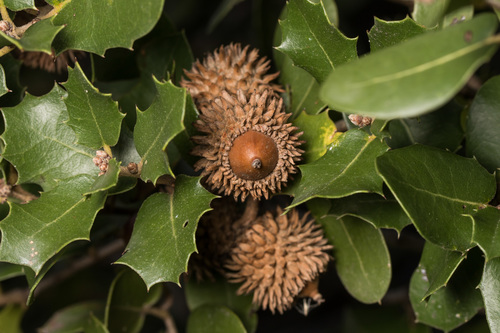
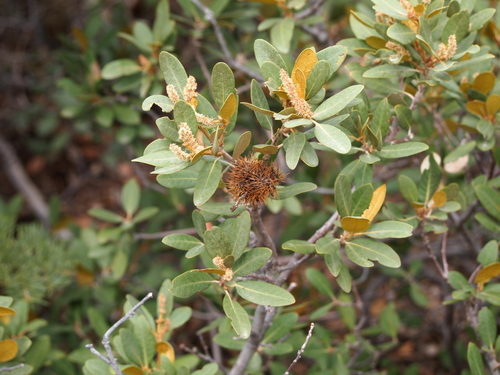
Chrysolepis sempervirens (Kellogg) Hjelmq. grows as a shrub that is typically less than 3 meters tall. Its bark is smooth, and colored gray or brown. In July and August, this shrub produces green catkins, which are spike-shaped inflorescences. These develop into yellowish fruit burs that are 20 to 60 mm thick, densely covered in spines, and hold between one and three light brown nuts. Young evergreen leaves have a golden surface on their abaxial (lower) side, and a green surface on their adaxial (upper) side; these leaves stay on the plant year-round. Rounded leaf tips distinguish C. sempervirens from C. chrysophylla, the only other species in the genus Chrysolepis, which grows in more coastal habitats. No subspecies or varieties of C. sempervirens are recognized. In ecology, C. sempervirens is generally more shade-tolerant than C. chrysophylla, so it can grow in the lower understory of coniferous forests. This shrub is wind-pollinated, and its fruit takes two years of development to ripen. The nuts are a good food source for birds and rodents, which also help disperse the species' seeds. For uses, the nuts of C. sempervirens are edible despite their small size, and have a flavor similar to hazelnuts. Indigenous peoples of California gathered and roasted these nuts to use as food. Currently, this species is occasionally grown as an ornamental shrub in native plant gardens. It is valued for its dense growth habit, attractive foliage, and ability to adapt to dry, rocky growing sites.