About Chrysoesthia sexguttella (Thunberg, 1794)
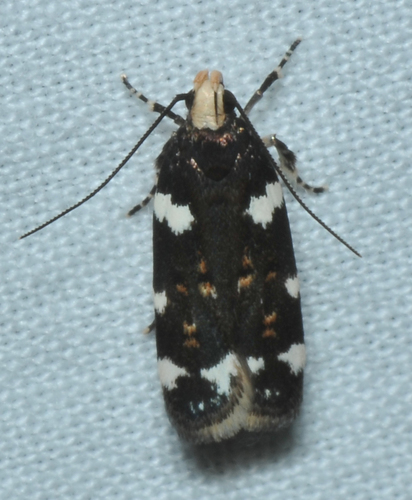
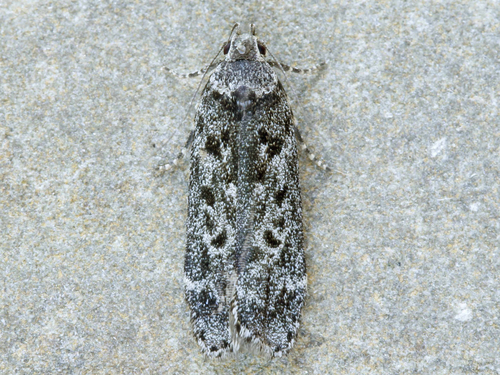
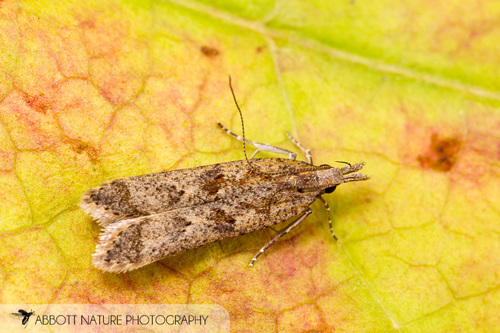
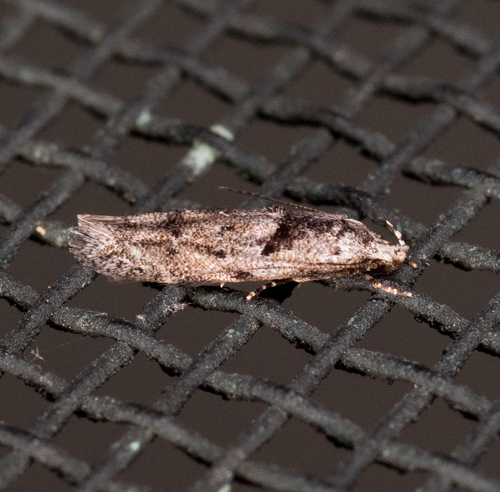
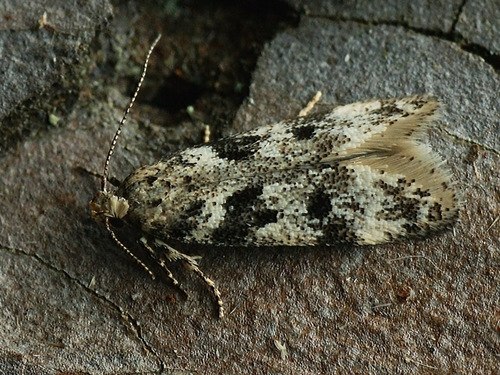
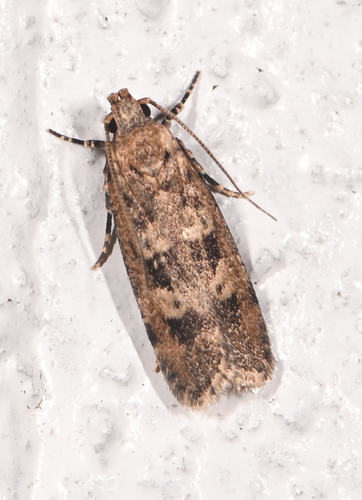
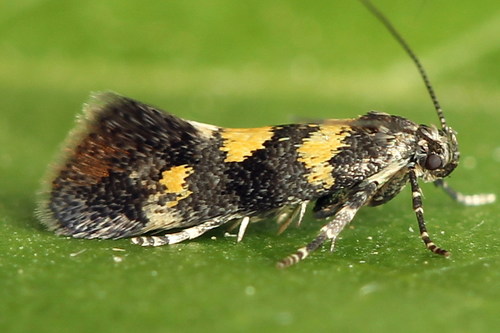
Chrysoesthia sexguttella, commonly known as the orache leafminer moth, is a moth species belonging to the family Gelechiidae. It is distributed across all of Europe, extending eastward to southern Siberia, and also occurs in northeastern North America, where it is possibly an introduced species. The wingspan of this moth measures 8 to 10 mm. Its head is metallic brassy-grey. The forewings are dark purplish-grey, mixed with black scales and marked with scattered whitish scales; they feature a yellow subdorsal spot at the middle, a smaller yellow spot in the posterior disc, an indistinct ochreous-white tornal spot, and another ochreous-white spot on the costa at the three-quarter position. The hindwings are grey. Fully developed larvae are yellow-whitish, with a brownish dorsal line, lateral lines formed of orange-reddish spots, a pale brown head, and a blackish plate on the second segment. Adult moths are active in flight from May to June, with a second active period from August to September. The species produces two generations each year. Larvae of Chrysoesthia sexguttella are leafminers that feed within the leaves of multiple plant genera and species: these include multiple Atriplex species (Atriplex cakotheca, Atriplex hastata, Atriplex hortensis, Atriplex littoralis, Atriplex prostrata, Atriplex nitens, Atriplex patula and Atriplex sibirica), multiple Chenopodium species (Chenopodium album, Chenopodium bonus-henricus, Chenopodium giganteum, Chenopodium glaucum, Chenopodium hybridum, Chenopodium murale, Chenopodium opulifolium, Chenopodium polyspermum, Chenopodium quinoa, Chenopodium urbicum and Chenopodium vulvaria), plus Amaranthus blitum, Amaranthus caudatus, Bassia scoparia, and Spinacia. Larval feeding creates a contorted gallery mine on the surface of the host leaf.