About Chrysocolaptes guttacristatus (Tickell, 1833)
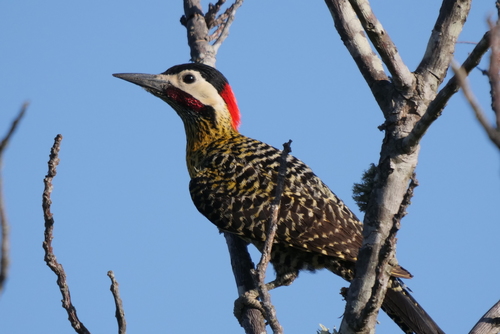
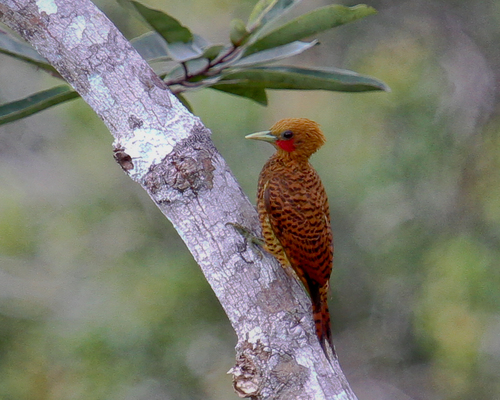
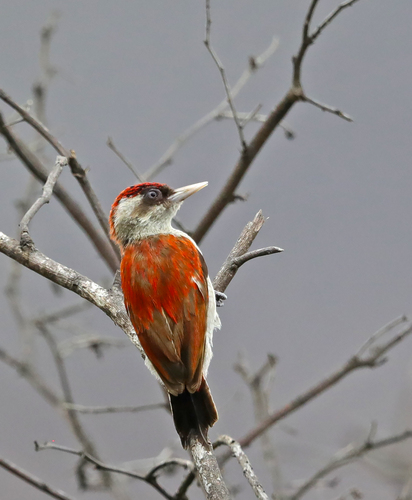
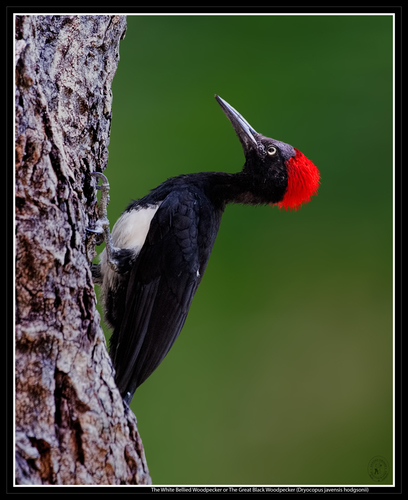
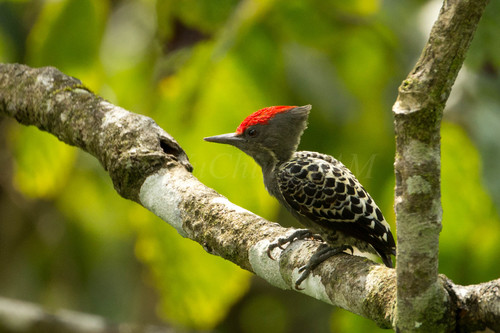
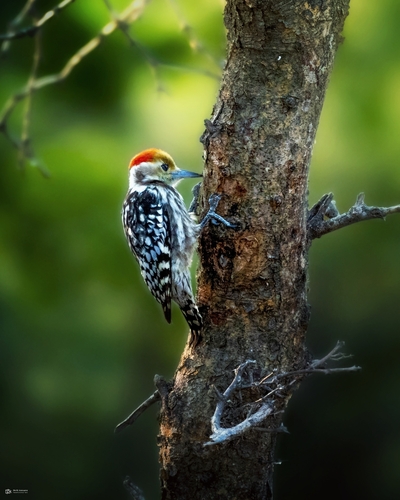
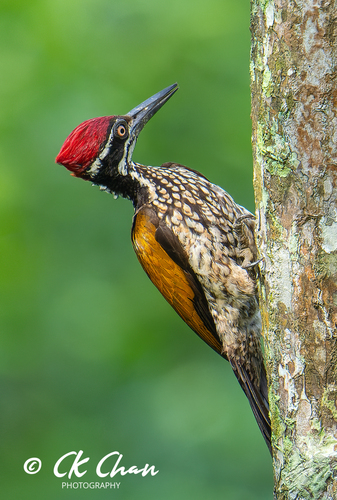
The greater flameback (Chrysocolaptes guttacristatus) is a large woodpecker that reaches 33 cm in length. It has the typical shape of a woodpecker, with an erect crest and a long neck. Its coloration varies widely between subspecies, but it always has unmarked golden-yellow to dark brown back and wings, a red rump, and a black tail. Its underparts are either white with dark markings including chevrons, stripes, or bands, or light brown. Its head can be whitish with a black pattern, or yellow, brown, or red. The straight-pointed bill is longer than the head. The legs have four-toed zygodactyl feet, with two toes pointing forward and two backward, and are lead-grey in color. The irises of the eyes range from whitish to yellow. All adult male greater flamebacks have a red crown. Female crown color varies by subspecies, and can be black spotted with white, yellow, or brown with lighter dots. Young birds resemble females but are duller, and have brown irises. This flameback species is associated with a variety of fairly open forest habitats, including those found in the Himalayan foothills and the Western Ghats, and it also lives in mangrove forests. It appears to be well-adapted to specific forest types, while the similar-looking common flameback (Dinopium javanense) is more of a generalist. For this reason, greater flameback can be more common than common flameback in some regions like Thailand, and less common in others like peninsular Malaysia, depending on which forest type dominates the area. For example, in Malaysian mangrove forests, greater flameback prefers to forage in tall Avicennia alba, while common flameback uses this species indiscriminately alongside Bruguiera parviflora and Sonneratia alba. Like other woodpeckers, the greater flameback uses its bill to dig food out of trees, and relies on its zygodactyl feet and stiff tail for support against tree trunks. It can dart its long tongue forward to extract wood-boring arthropod prey. While it mainly feeds on small invertebrates, greater flamebacks also drink nectar. They nest in tree holes, and lay three or four white eggs.