About Chrysococcyx xanthorhynchus (Horsfield, 1821)
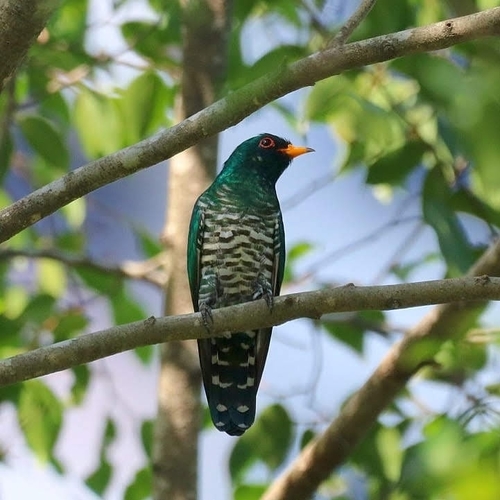
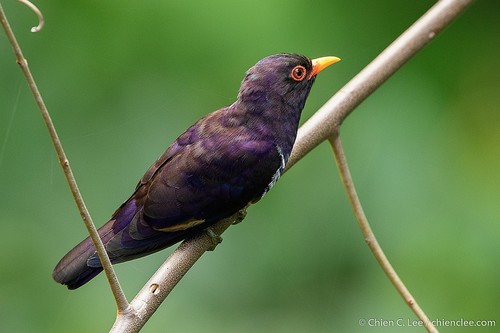
This species, the violet cuckoo, has the scientific name Chrysococcyx xanthorhynchus (Horsfield, 1821). Males have glossy violet feathers on the head and upper body. Their blackish tail has a white tip, with barred outer feathers. The most striking feature is the brightly iridescent violet chin and upper breast. The belly is white with broad black, green, or violet bars, and mature males also have a red eye-ring. When compared to its closely related species C. amethystinus, C. xanthorhynchus has a reddish violet throat, while C. amethystinus has a glossy blue-violet throat patch instead. Females have mottled greenish-bronze upper parts and a dark brown crown. They have white markings around the eyes, and sometimes these markings also appear on the forehead. Their central tail feathers are greenish, while the outer feathers are rufous with greenish bars. The outer rectrices are barred black and white. The breast is whitish with bronze-green bars and variably washed rufous markings. Juveniles have barred rufous and greenish bronze feathers on the upper body, a bright rufous crown, rufous and mottled green or brown wings, a barred brown and rufous tail, and brown-barred white underparts. The violet cuckoo is distributed from north-eastern India to Southeast Asia, Greater Sundas, Palawan, and the Philippines. Southern populations are resident, while northern populations in locations such as Assam and Bangladesh are thought to be migratory. Its natural habitats are subtropical or tropical moist lowland forests and subtropical or tropical mangrove forests. It can also be found in gardens, orchards, and rubber plantations. It occurs from lowlands up to 1500 m in elevation, but is found mainly below 700 m. This species is reported to be uncommon across its entire range. Because it has a wide range, the IUCN does not consider the species to be threatened. However, one source notes that the species is threatened in parts of its range due to habitat loss.