About Chrysococcyx lucidus (Gmelin, 1788)
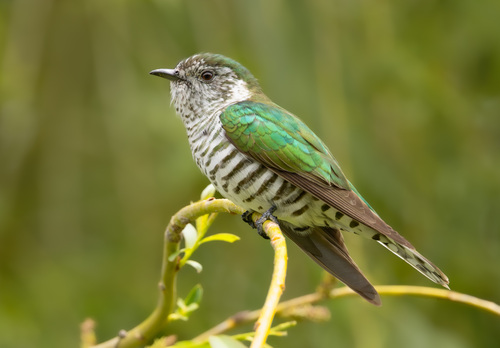
The shining bronze cuckoo (Chrysococcyx lucidus, Gmelin, 1788) is hard to spot, and easier to identify by sound. This species measures 13–18 cm (5.1–7.1 in) in total length, has a 25–32 cm (9.8–12.6 in) wingspan, and weighs approximately 25 g (0.88 oz). It is slightly larger than Horsfield's bronze cuckoo (Chalcites basalis). It has metallic golden or coppery green upperparts, white cheeks, and white underparts barred with dark green. Females have similar overall plumage, with a more purplish sheen on the crown and nape, and bronzer-tinged barring on the belly. Both sexes have black bills and black feet with yellow undersides. As a summer visitor, the shining bronze cuckoo occurs in eastern Australia, ranging from Cape York Peninsula in Queensland to Eyre Peninsula and Kangaroo Island in South Australia, plus Tasmania. It also visits Western Australia in summer, from Carnarvon in the north to the southwest, and east to Esperance. These Australian populations spend winter in the Lesser Sunda Islands and New Guinea. New Zealand breeding populations winter in the Solomon Islands; they arrive in New Zealand starting mid August, and are not common until October. They spread out to Stewart and Chatham Islands, and are found up to an altitude of 4,000 ft (1,220 m). Two island subspecies are non-migratory: layardi lives in New Caledonia, Vanuatu and some islands of the Solomon Islands, while harterti lives on Rennell and Bellona Islands in the Solomons. The shining bronze cuckoo is insectivorous, and eats insects that most other birds avoid, such as caterpillars, particularly those of the magpie moth, and beetles, particularly ladybirds. The species' gizzard is lined with a thick soft lining that catches caterpillar spines; these spines later fall away and are spat out by the bird. The shining bronze cuckoo is also known to eat bird eggs.