About Chrysochus auratus (Fabricius, 1775)
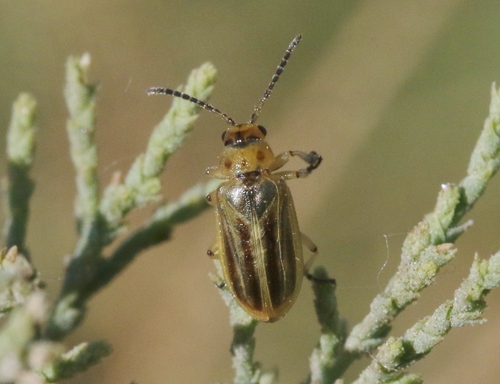
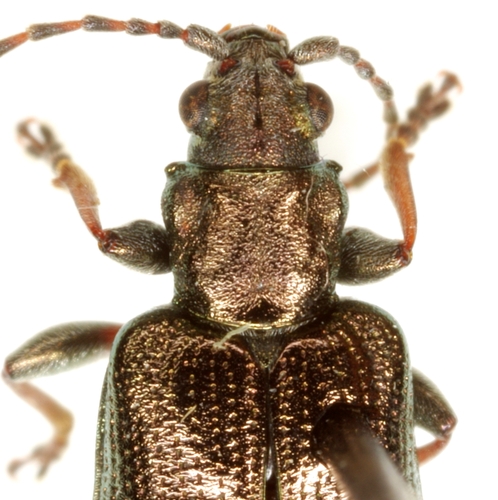
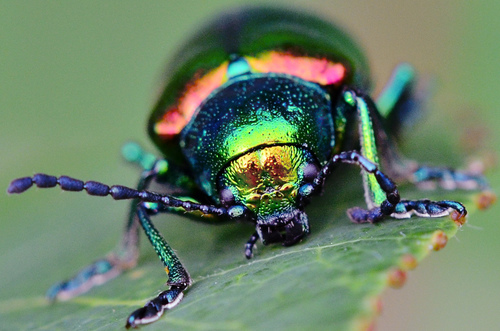
Chrysochus auratus, commonly known as the dogbane beetle, is a species of leaf beetle. It is 8 to 11 mm long, with an oblong, convex body shape. It has two pairs of wings, including a pair of copper-colored elytra, and typically has a blue-green hue. This coloration helps it deter potential predators.
Dogbane beetles have a highly polygamous mating lifestyle. They can interbreed with the related species Chrysochus cobaltinus in overlapping geographic regions, producing hybrid offspring. Their diet consists almost exclusively of dogbane plants from the genus Apocynum, specifically Apocynum cannabinum and Apocynum androsaemifolium. They have evolved multiple adaptations that allow them to feed on these toxic plants.
The dogbane beetle's native range covers eastern North America, spanning the entire eastern United States and extending into adjacent southern Canada west of the Rocky Mountains. At the western edge of its range, it reaches west of the Rocky Mountains into Arizona and Utah. The closely related C. cobaltinus is found only in western North America. Historically, the two species were thought to have completely separate allopatric distributions, but researchers have recently documented at least two narrow overlapping regions in western North America where both species occur and interbreed.
After hatching from eggs in midsummer, first instar larvae drop to the ground and burrow into the soil. There they feed on the tuberous rhizomes of Apocynum plants. Apocynum contains toxic cardenolides that are poisonous to most animals, so this diet protects larvae from predation by parasitic wasps. Later, larvae pupate inside a chamber within the same soil. Virgin adults remain in these underground chambers until their bodies have fully hardened, which is usually in early summer, when they emerge. Once emerged, adults stay within their host plant patch for six to eight weeks. Dogbane beetles produce one generation per year.
Beetles in the genus Chrysochus generally feed on various dogbane plants in the Apocynaceae family, which includes milkweeds of the subfamily Asclepiadoideae. C. auratus is an exception that feeds exclusively on non-milkweed dogbane plants. Larvae feed on the plant's roots, while adults feed on the leaves.
As a defense against herbivores, Apocynum plants produce toxic cardenolides. These compounds can be fatal to many organisms, including humans, where consumption can cause cardiac arrest. C. auratus has evolved both behavioral and physiological adaptations to overcome these plant defenses. Physiologically, C. auratus has a single amino acid substitution in the Na+/K+-ATPase protein that reduces the ability of cardenolides to bind and block this vital transmembrane carrier, which controls cell potential balance and is critical for nervous system function. The beetle can not only process the toxic cardenolides, but also accumulates the compound in its own body to further deter predators. Cardenolides are transported through the beetle's body to cuticular glands, including glands located on the elytra and wings. When the beetle is disturbed, it secretes cardenolides to poison threatening enemies. This same adaptive mutation is also seen in the cardenolide-insensitive monarch butterfly.
Behaviorally, C. auratus has a specialized feeding method to avoid the toxic sticky white latex that Apocynum plants release from broken stems and leaves as defense. When feeding, adult beetles feed at leaf margins. They first chew a 5-to-7-millimeter diagonal channel that runs from the leaf margin toward the leaf apex. This channel cuts across the leaf's major veins, which causes the leaf to exude most of its defensive latex through the cut. The tissue distal to this initial cut has much lower latex content, and the beetle feeds exclusively on this lower-latex tissue with a downward biting motion. Feeding takes approximately one minute, and the beetle straddles the leaf margin while feeding. As it feeds, latex accumulates on the ventral segments of the beetle's mouth from the repeated downward head movements. After finishing feeding, the beetle moves from the leaf margin toward the leaf center, presses its mouth to the leaf surface, and drags its mouth across the leaf while walking backward to remove the accumulated latex. Evidence of this feeding behavior can be seen on consumed leaves as rings of dried latex near the feeding site.
Apocynum is a native perennial weed that negatively impacts cultivated lowbush blueberries. Its sprouts interfere with blueberry growth and harvest by shading blueberry plants, and its toxic latex sap can potentially poison blueberries. Controlling Apocynum spread is difficult, because only a few effective herbicides exist, and most of these also harm blueberry plants. Because C. auratus feeds exclusively on Apocynum, it has been considered as a candidate biological control agent for agricultural use. Research consistently shows that while releasing high numbers of C. auratus can significantly reduce Apocynum growth and spread, naturally occurring populations of the beetle are not dense enough to control Apocynum on their own. As a result, many integrated dogbane management programs are developing strategies to conserve and increase C. auratus populations for agricultural use.
C. auratus has also been considered as a potential biological control agent for Vincetoxicum rossicum, a non-native European vine in the Apocynaceae family. However, experiments show that while C. auratus is very reproductively successful on A. cannabinum and A. androsaemifolium, this is not true for V. rossicum. Female dogbane beetles lay eggs on the undersides of leaves, and experiments have found that V. rossicum leaves act as an oviposition sink for C. auratus eggs: eggs laid on these leaves have a much lower probability of successful larval development and survival. For this reason, C. auratus is not expected to be a successful control agent for V. rossicum, unlike native Apocynum weeds.