About Chrysiridia rhipheus Drury, 1773
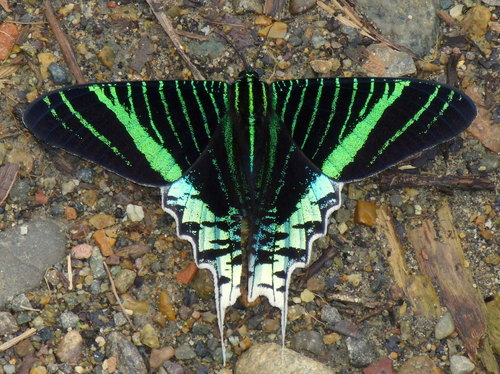
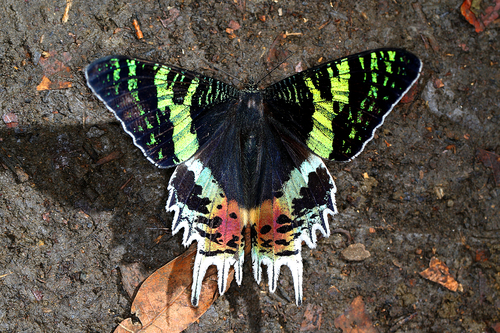
Chrysiridia rhipheus Drury, 1773, commonly called the sunset moth, has a wingspan ranging from 7 to 9 centimetres (2.8 to 3.5 in), and can occasionally reach up to 11 centimetres (4.3 in). Moths collected from highlands between 900 and 1,080 metres (2,950 to 3,540 ft) have a median wingspan of 7 cm (2.8 in), while moths from lower altitudes around 600 m (2,000 ft) have a median wingspan of 9 cm (3.5 in). Like many other uraniine moths, the sunset moth bears a striking resemblance to swallowtail butterflies, particularly in its wing tails and colorful patterning, and can easily be mistaken for a butterfly. Its base body and wing color is black, marked with iridescent red, blue, and green patterns. A fringe of white scales lines the edges of its wings, which is wider on the hindwings. The moth has six wing tails, which are very often lost or damaged over the course of its life. Pattern variation across individuals is common, and the moth is frequently partly asymmetrical; one known cause of this asymmetry is temperature shock during the pupal stage of development. Early sources had conflicting ideas about the species' origin: the type specimen sent to Drury was believed to have come from China, while Cramer thought it originated from Chandernagore in Bengal, a confusion that gave rise to the French name "page de Chadernagor". It is now confirmed that Chrysiridia rhipheus is endemic to Madagascar. Thousands of adult moths undertake seasonal migrations between geographically isolated populations of their host plants, which are members of the genus Omphalea. They can be found across almost all of Madagascar, except the island's south-west and the extreme subdesertic south of the Androy region, where their host plant does not grow. Their migration runs from the three Omphalea species found in western Madagascar's dry deciduous forest (O. ankaranensis, O. occidentalis, and O. palmata) to the Omphalea species native to eastern Madagascar's rainforest (O. oppositifolia). The western Omphalea species are mostly located within protected areas, while the eastern O. oppositifolia is mostly unprotected, occurs in widely scattered populations, and is threatened by deforestation. As the only evergreen species in the genus, O. oppositifolia is likely critical to the long-term survival of C. rhipheus. The Jamaican uraniine moth Urania sloanus, a related species in the same subfamily, most likely became extinct after the loss of one of its host plant species. C. rhipheus migrations occur in response to changes in their host plants. C. rhipheus larvae completely defoliate host plants, and even consume the plants' flowers and fruit, which has a considerable negative impact on host plant seedling survival and reproduction. In response, host plants likely change their nutrient and secondary compound levels, becoming toxic to moth larvae and causing high larval mortality. Omphalea populations that have not been damaged by moths for long periods have lower toxicity. These factors drive large increases in local moth populations, followed by sudden population crashes. While population crashes could result from increased larval mortality, they are more likely caused by adult moths emigrating from the area. Through semiochemical signals, host plants may recruit hymenopteran parasitoids as a protective measure, which also influences the moth's population dynamics. C. rhipheus has continuous overlapping generations year-round. Population sizes are highest from March to August (fall and winter in Madagascar), and lowest from October to December (spring). Females lay their eggs late in the afternoon or at nightfall, and locate potential oviposition sites by sight. Like other uraniid moth eggs, sunset moth eggs are domed with projecting ribs. A single egg weighs approximately 1 milligram (3.5×10⁻⁵ oz) and usually has 17 ribs, though it may have 18, or less often 16. Eggs are usually laid on the lower surface of Omphalea leaves, and occasionally on the upper surface. They are laid in groups of 60 to 110 eggs, most often around 80 eggs per group. After hatching, young caterpillars only eat the parenchyma tissue between the leaf veins, a behavior that lets them avoid the sticky, toxic latex produced by the plant's laticifers and carried in the veins. After 3 to 4 days, caterpillars begin eating flowers, fruit, tendrils, petioles, and young stems in addition to leaves, and can completely defoliate the entire host plant. They particularly prefer feeding on the glands at the base of the leaf, near the petiole. They are able to tolerate the chemical defenses in the plant's latex, which does not cause mouthpart coagulation problems for them. As they walk, caterpillars spin silk from their mouth with an ∞-shaped head movement; this keeps them from falling off the smooth surface of leaves, and lets them climb back onto the plant if they do fall. Heavy rain can knock caterpillars off plants even with this silk anchor. There are four larval instars, and the caterpillar stage lasts two months in the warm season, and two and a half to three months in the cold season. Mature caterpillars are whitish yellow with black spots, red feet, and are covered in club-ended black setae. They have five pairs of prolegs on abdominal segments 3 to 6 and 10, plus six true legs attached to the thorax. After completing all but its final molt, the caterpillar spins an open silk cocoon with a large, irregular mesh. Cocoons may be built in the tree crown or between two leaves, but are most often found near the ground, between moss and bark. In the warm season, spinning the cocoon takes around 10 hours; metamorphosis begins about 29 hours after spinning is complete and lasts around 6 minutes. All these durations are slightly longer in the cold season. The chrysalis stage lasts 17 days in November, Madagascar's warmest month, and 23 days in July, the coldest month. Five to six days before the adult moth emerges (eclosion), the wing patterns begin to become visible. The moth emerges during the night or in low light by splitting the pupal case from the top. Once it exits the pupal exoskeleton, the moth finds a horizontal surface and suspends itself from it using its four anterior legs. The wings expand over about 10 minutes as the moth pumps haemolymph into the wing veins. The moth then beats its wings a few times, waits 45 minutes for the wings to harden, and beats them lightly again. The moth takes its first flight between one and a half and two hours after emergence.