About Chrysina gloriosa (LeConte, 1854)
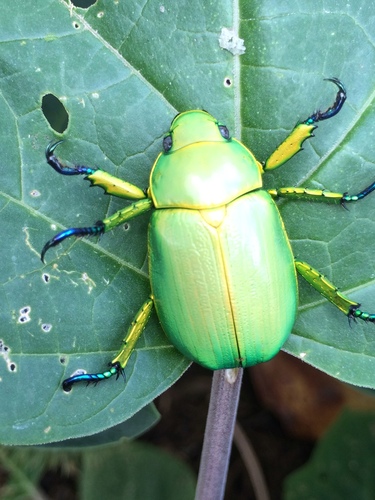
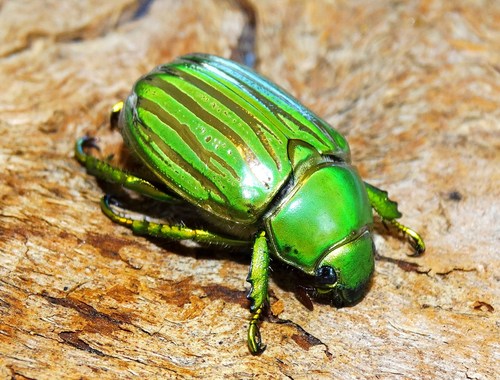
Chrysina gloriosa, a species of scarab beetle, has two common names: glorious beetle and glorious scarab. The species was formerly known under the synonym Plusiotis gloriosa. It is found only in the southern United States – specifically southeastern Arizona, southern New Mexico, and southwestern Texas – and northern Mexico, in the states of Chihuahua and Sonora. Adult Chrysina gloriosa measure 20 to 30 millimetres (0.8–1.2 inches) in length. They are typically bright green with silver stripes across their elytra; rare red and purple color forms also exist. The iridescent appearance of the elytral cuticle stripes comes from cholesteric liquid crystal organization of chitin molecules. Color differences between sections are created by microscopic structural differences: green is reflected from cusp-like structures, while silver is reflected from flat layers that lie parallel to the elytra surface. As confirmed by Mueller matrix spectroscopic ellipsometry, the beetle's optical properties change depending on the incidence angle of incoming light. The polygonal cells that make up the green stripes produce self-healing Bessel beams. Adults are active both day and night, and are most commonly seen between June and August. Their primary food source is juniper leaves, but they will also visit flowers, where they act as incidental pollinators by transferring pollen as they move between blooms. Larvae feed on decaying wood from Arizona sycamore. Contrary to a common incorrect belief, Chrysina gloriosa has never been officially recognized as an endangered species. It has never been rated by the IUCN, nor is it listed under the United States Endangered Species Act, and it can be locally abundant.