About Chrysemys picta (Schneider, 1783)
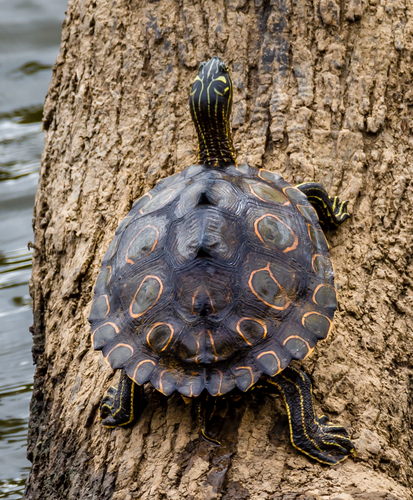
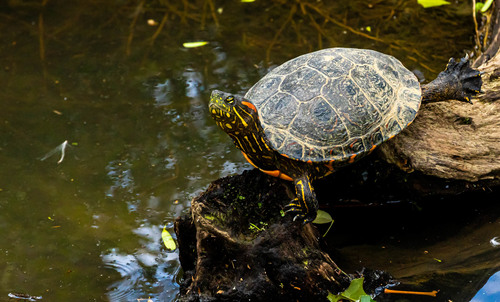
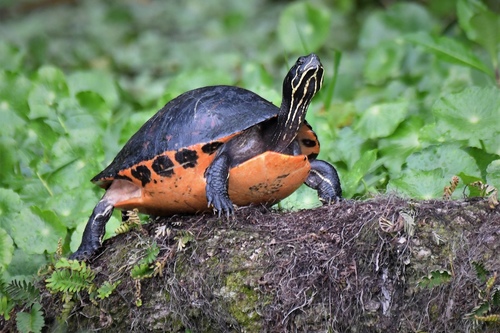
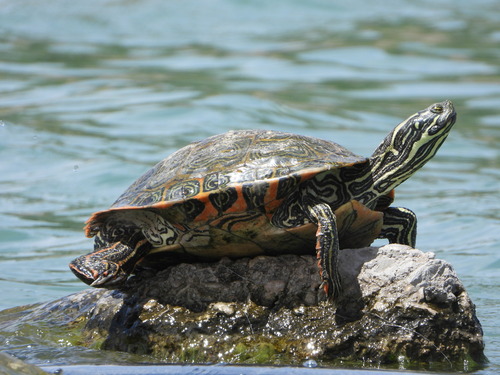
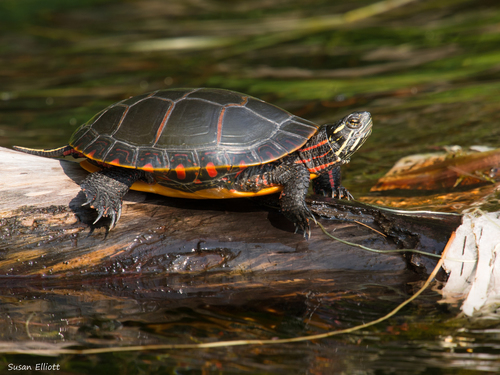
Chrysemys picta, commonly called the painted turtle, is a species of turtle first described by Schneider in 1783. Adult painted turtles reach a total length of 13–25 cm (5–10 in), with males consistently smaller than females. Adult females average 10–25 cm (4–10 in) long, while adult males average 7–15 cm (3–6 in) long. On average, adult females weigh around 500 g (18 oz), and adult males weigh roughly 300 g (11 oz); females have greater body volume to support egg production. For any given body length, females have a higher, more rounded top shell than the flatter top shell of males. Males also have longer foreclaws, a longer thicker tail, and a cloaca (anus) positioned further out along the tail. The painted turtle has an oval, smooth shell with shallow grooves at the overlaps of its large scale-like plates, and a flat-bottomed shell. The top shell (carapace) ranges in color from olive to black, with darker individuals more common in water bodies with darker bottoms. The bottom shell (plastron) is yellow, sometimes red, and occasionally has dark markings in its center. Like the carapace, the turtle’s skin is olive to black, and marked with red and yellow stripes along the neck, legs, and tail. As with other pond turtles such as the bog turtle, painted turtles have webbed feet to assist with swimming. The species has a distinctive head shape and markings: the face only bears yellow stripes, with a large yellow spot and streak behind each eye, and two wide yellow stripes on the chin that meet at the tip of the jaw. The upper jaw is shaped into an inverted "V" (philtrum), with a downward-facing tooth-like projection on each side. Compared to adults, hatchlings have proportionally larger heads, eyes, and tails, and a more circular shell. This is the most widespread turtle native to North America, and it is the only North American turtle whose native range stretches from the Atlantic coast to the Pacific coast. It is native to eight of Canada’s ten provinces, 45 of the fifty United States, and one state in Mexico. On the East Coast, its range extends from the Canadian Maritimes south to the U.S. state of Georgia. On the West Coast, it occurs in British Columbia, Washington, Oregon, and on offshore southeast Vancouver Island. It is the northernmost turtle native to North America, and its range covers most of southern Canada. To the south, its range reaches the U.S. Gulf Coast in Louisiana and Alabama. In the southwestern United States, only scattered populations exist. A single population is found in one river in extreme northern Mexico. It is absent from a region of southwestern Virginia and adjacent adjacent states, as well as from north-central Alabama. There are four recognized subspecies of painted turtle. Borders between these subspecies are not sharp, because the subspecies interbreed. In the southeast, the Appalachian Mountains create a clear divide between midland and eastern painted turtles, but the two subspecies interbreed and mix in the northeast. Many studies of border populations have examined intermediate hybrid turtles formed through intergradation of the traditionally recognized subspecies. Despite this imprecise differentiation, the subspecies are still assigned nominal ranges. Pet releases have begun establishing introduced painted turtle populations outside of the species’ native range. Introduced populations have been recorded in waterways near Phoenix, Arizona, as well as in Germany, Indonesia, the Philippines, and Spain. To thrive, painted turtles require fresh water with soft bottoms, basking sites, and aquatic vegetation. They occupy shallow, slow-moving water habitats including creeks, marshes, ponds, and lake shores. Different subspecies have evolved distinct habitat preferences. The eastern painted turtle is highly aquatic, only leaving the immediate area of its water body when forced to migrate by drought. Along the Atlantic coast, eastern painted turtles have been found in brackish waters. They occur in wetland areas including swamps and marshes with thick mud layers, as well as areas with sandy bottoms and abundant vegetation. Warmer climate areas host higher relative population densities, and density is also influenced by habitat desirability. Midland and southern painted turtles prefer particularly calm waters, usually shorelines and coves. They favor shallow areas with dense vegetation, and have an unusual tolerance for pollution. Western painted turtles live in streams and lakes similarly to other subspecies, but also occupy pasture ponds and roadside pools, and can be found at elevations as high as 1,800 m (5,900 ft). In the early 1990s, trade data found painted turtles were the second most popular pet turtle species, after red-eared sliders. As of 2010, most U.S. states allow keeping painted turtles as pets but discourage the practice. Oregon fully forbids keeping painted turtles as pets, and Indiana prohibits the sale of the species. U.S. federal law bans the sale or transport of any turtle smaller than 10 cm (4 in), to reduce human exposure to salmonella. A loophole for scientific specimens allows some small turtles to be sold, and illegal trafficking of small turtles also occurs. Painted turtle pet care requirements are similar to those of red-eared sliders. Keepers are advised to provide adequate space, a basking site, and regularly filtered and changed water. Aquatic turtles including painted turtles are generally unsuitable pets for children, as they do not like being held. Hobbyists have kept painted turtles in captivity for decades, and the species can live up to 40 years in captivity as a long-lived pet. Painted turtles are sometimes eaten, but are not considered a desirable food source: even the largest subspecies (the western painted turtle) is inconveniently small, and larger turtle species are available. Schools frequently dissect painted turtles, which are sold by biological supply companies; specimens used for dissection are often wild-caught, but may also be captive-bred. In the Midwest of the United States, turtle racing with painted turtles is a popular activity at summer fairs.