About Chrysaora hysoscella (Linnaeus, 1767)
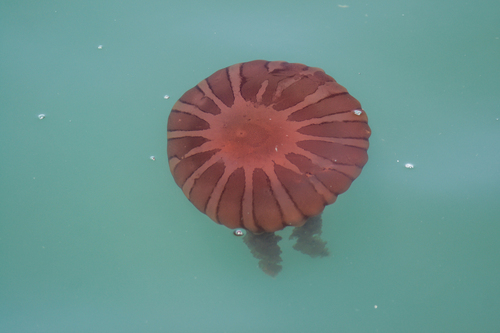
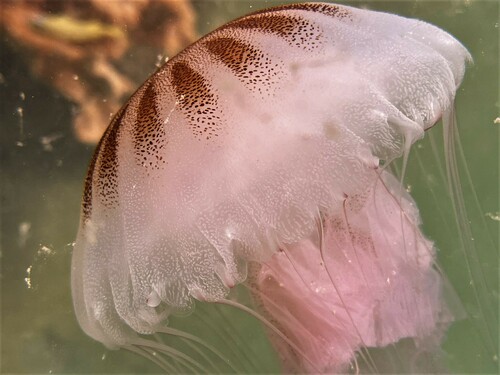
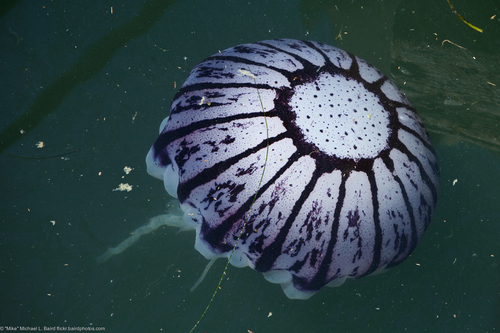
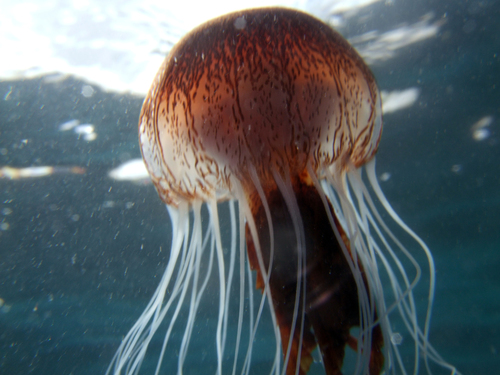
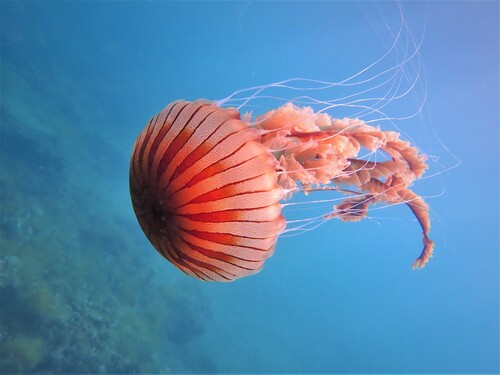
Chrysaora hysoscella, commonly known as the compass jellyfish, is a common true jellyfish species that lives in coastal temperate waters of the northeastern Atlantic Ocean, including the North Sea and Mediterranean Sea. Historical records of this species from the southeastern Atlantic near South Africa are incorrect; these sightings were due to confusion with closely related species: C. africana, C. fulgida, and an undescribed species tentatively called "C. agulhensis". This species has radial symmetry, with distinct elongated V-shaped brown markings on its bell. Adult C. hysoscella are highly susceptible to infection by the parasite Hyperia medusarum, but this parasite does not cause significant impacts to the overall C. hysoscella population. Before maturing into free-swimming pelagic adult medusae, this species goes through a benthic polyp life stage. Compass jellyfish feed on a wide range of marine invertebrates and plankton, and have very few natural predators. C. hysoscella contributes to the global problem of jellyfish overpopulation, which is a concern for humans for multiple reasons: it interferes with recreational activities, causes economic disruption for fishing communities, and reduces available fish resources. The compass jellyfish lives in coastal waters of the northeast Atlantic, including the Celtic Sea, Irish Sea, North Sea, and Mediterranean Sea. It mostly occupies the upper section of the water column. Though it lives in shallow water, it moves vertically through the water column regularly, ranging from the surface waters to just above the seabed. It is rarely found deeper than 30 meters below the surface. Like other scyphozoans, Chrysaora hysoscella undergoes metamorphosis during development, progressing through a polyp stage before reaching the medusa form. Females release planular larvae, which swim to find an appropriate location to settle. Once settled, the planulae attach to a benthic substrate and develop into sessile polyps. These polyps release immature medusae through asexual reproduction called strobilation. When C. hysoscella first matures, it functions as a male, and later develops female gametes; this makes the species protandrously hermaphroditic. Chrysaora hysoscella uses both sexual and asexual reproduction across its life cycle. Mature individuals reproduce sexually via broadcast spawning. Males release sperm through their mouths into the water column. Females take in this sperm to fertilize eggs internally, and can fertilize eggs with sperm from multiple different male partners. The larvae females release settle to become benthic polyps, which reproduce asexually. The polyps release multiple ephyrae, the earliest life stage of the medusa form, through strobilation. Research shows that C. hysoscella polyps can release ephyrae over an extended period of time, so they are not restricted to only one reproductive event.