About Chrysaora fuscescens Brandt, 1835
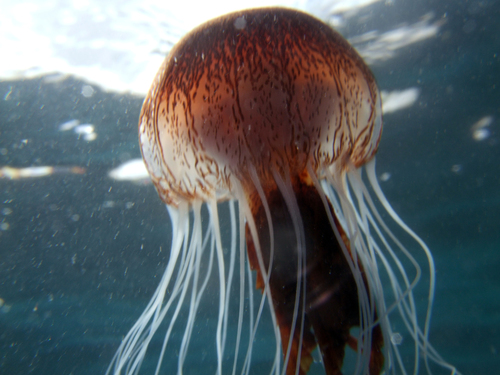
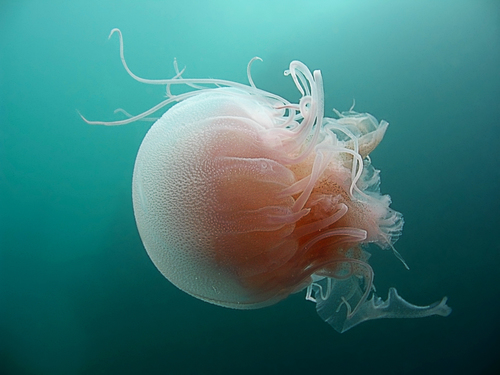
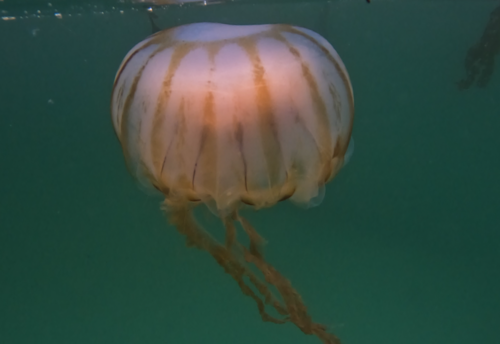
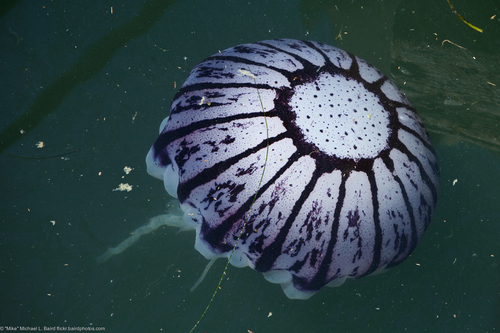
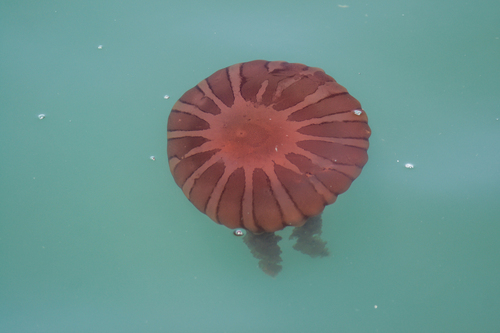
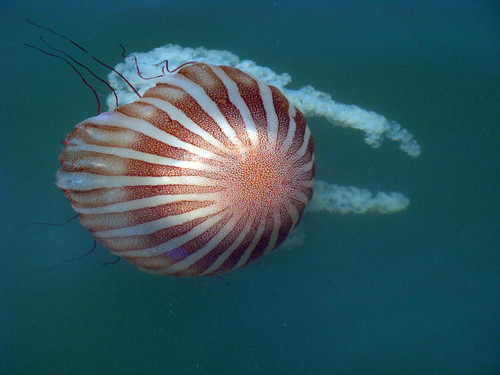
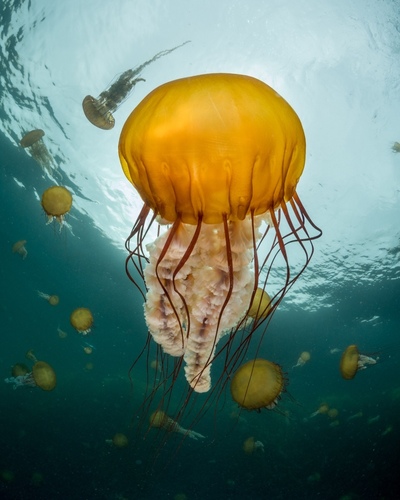
Chrysaora fuscescens, commonly known as the Pacific sea nettle or West Coast sea nettle, is a widespread planktonic scyphozoan cnidarian (a type of medusa, commonly called jellyfish or jelly). It inhabits the northeastern Pacific Ocean, found in temperate to cooler waters off British Columbia, the West Coast of the United States, and ranges south to Mexico. This species gets its common name from its defensive nettle-like sting; like the stinging nettle plant Urtica dioica, the Pacific sea nettle’s sting is often irritating and possibly mildly painful to humans, but it is rarely dangerous. The Pacific sea nettle has a distinctive golden-brown bell, the main body or head of a jellyfish, with a reddish tint. In wild populations, the bell can grow to over one meter (3 feet) in diameter, though most individuals are less than 50 cm across. It has long, spiraling whitish oral arms and 24 undulating maroon tentacles that may trail as far as 15 feet (4.6 m) behind the jelly. Since around the mid-20th century, C. fuscescens has been a very popular cnidarian to display in aquariums, and even some zoos with aquatic exhibits. This popularity comes from public fascination with its bright colors and extremely long tentacles, plus the species is quite low-maintenance in captivity when kept with appropriate water parameters and conditions. When thriving under ideal conditions, these medusae can even be easily bred through culturing polyps. Chrysaora fuscescens is most commonly found along the coasts of southern British Columbia, Washington, Oregon, most of California, and down to Baja California Sur, Mexico. A small number of individuals range further north to the Gulf of Alaska, west to Japan, and rarely into the Gulf of California. Population numbers of this species reach their peak during late summer. In recent years, C. fuscescens has become overly abundant off the coast of Oregon. Some researchers believe this overabundance is an indicator of climate change, while others suspect the population increase is caused by human influences on coastal regions. Industrial runoff, agricultural waste, and other forms of human pollution including fertilizers and waste from chemical plants add large amounts of nutrients to ocean water when they enter the ocean. These nutrients feed microorganisms and fuel algal blooms, which in turn support the entire local food chain, potentially providing enough extra food for sea nettles to support a population increase. Chrysaora fuscescens can reproduce both sexually during the medusa life stage and asexually during the polyp life stage. The species' life cycle starts when females catch sperm released by males to fertilize the eggs they have produced and hold in their mouth. Fertilized eggs stay attached to the female's oral arms, where they develop into flat, bean-shaped planula. Once they grow into flower-shaped polyps, they are released into the ocean, where they attach to a solid surface and undergo asexual reproduction. Polyps produce identical copies of themselves through budding, where a new polyp grows from the side of the original. When the new polyp is fully formed, it is released into the ocean and goes through metamorphosis as it grows, developing a bell, arms, and tentacles until it becomes a fully formed medusa.