About Chrosomus neogaeus (Cope, 1867)
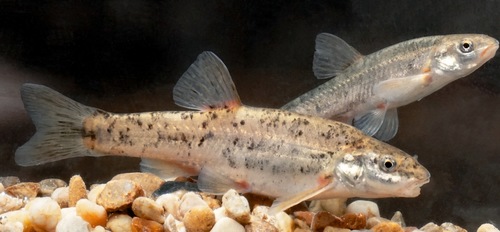
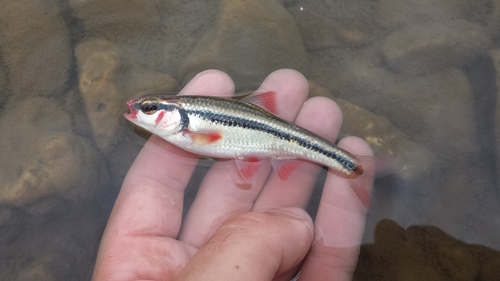
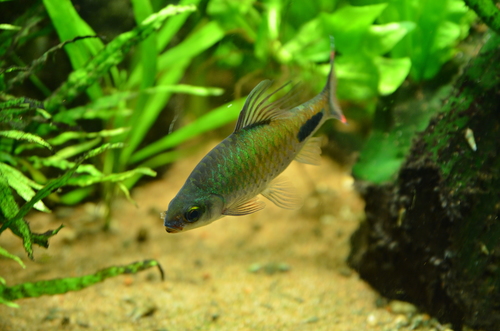
Chrosomus neogaeus, commonly called the finescale dace, gets its name from the fine scales covering its body. This species has a large, blunt head, dark lateral bands that run parallel along the length of its bronze and black body. Each lateral line may hold more than 80 scales, which are classified as leptoid scales: thin, flexible scales that cover the entire body of the fish. Leptoid scales are divided into two specific groups, and the finescale dace has ctenoid scales, named for the cteni that run along the posterior area of the fish. The finescale dace has a lateral line system that lets it orient itself in moving water. Its main row teeth are most commonly distributed 5–4, but have also been recorded as 4–4, 4–5, and 5–5. The fish has paired pectoral and pelvic fins: pectoral fins sit on the sides of the body, while pelvic fins are positioned in the thoracic area. Adult finescale dace typically range in size from 60 to 70 millimeters (2.4 to 2.8 inches) long, about the length of an average person's thumb.
The finescale dace is distributed across southern and northwestern Canada, south into Minnesota and the Great Lakes Basin. In Minnesota, populations inhabit Brule Lake, as well as bodies of water in the Lake Superior drainage areas of St. Louis and Cook counties. The species also lives in Great Lakes drainage stream regions of Wisconsin, though it is rarely seen in southern Wisconsin. Though it is primarily a northern species, glacial relict populations exist in the Sand Hills of Nebraska, the Black Hills of South Dakota, Colorado, and parts of Wyoming.
This fish is most often found in cool, acidic northern waters, specifically in the calm waters of slow-moving creeks and cool, boggy ponds. Beaver ponds are excellent habitat for the species, where they hide among sunken logs and downed brush for safety. Finescale dace prey on tiny invertebrates, including small insects such as water beetles. Their diet also includes a variety of crustaceans, plankton, and algae; in northern Minnesota, they also eat fingernail clams.
Breeding occurs from April to June, when stream temperatures reach at least 15 degrees Celsius. During breeding season, males develop yellow and red pigments on the underside of their body to signal sexual readiness to females. The bright coloration attracts duller-colored females to large depressions in the stream's sandy bottom, underneath waterlogged timber and brush. The pair swims into the depression together; the female lays her eggs while the male fertilizes them. The eggs settle to the stream bottom and are left unattended by both parents. The entire breeding process takes only fifteen to thirty seconds. Spawning continues for several more days, which exhausts the female. She can lay several hundred more eggs over the spawning season, with the total number depending on her size and reproductive fitness. If they avoid predation, the eggs resting in the depressions hatch in 4 days.
Finescale dace can reproduce with the northern redbelly dace, Chrosomus eos, producing hybrid offspring that are always female. Female finescale dace benefit from growing larger and living longer than males, as this allows them to reproduce for longer and produce more viable eggs. The largest documented female, recorded in Minnesota, measured 85 mm (3.3 in) long and was approximately six years old. In a similar Minnesota location, the largest recorded male was 58 mm (2.3 in) long and roughly five years of age. Most individuals of both sexes live three to four years, with an average adult length of 60–70 mm (2.4–2.8 in).