About Chrosomus erythrogaster (Rafinesque, 1820)
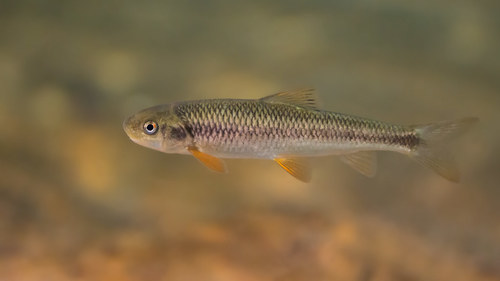
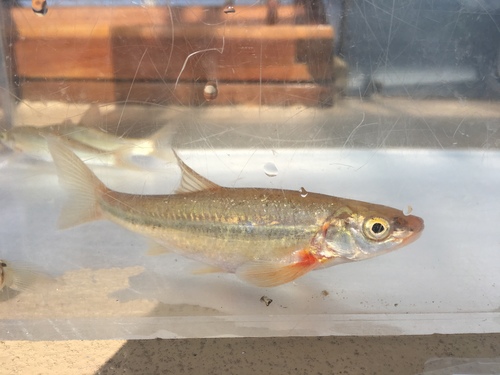
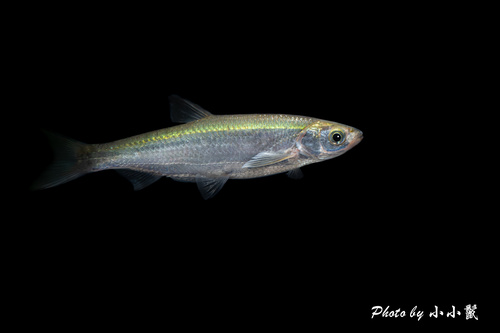
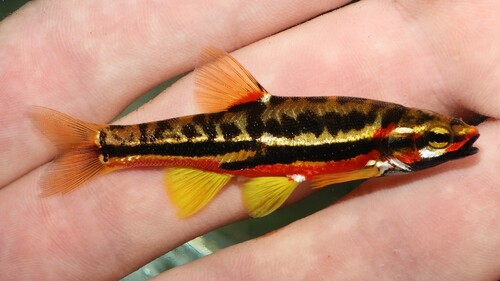
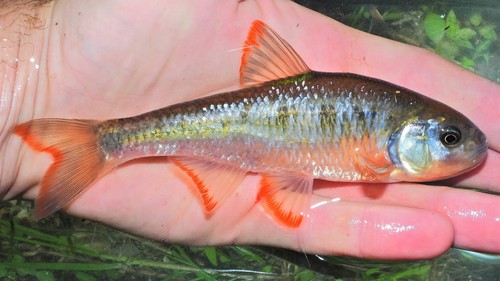
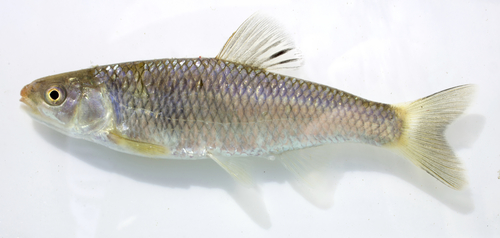
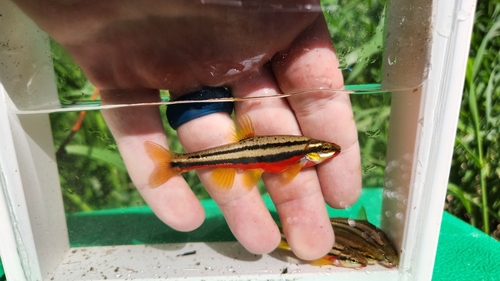
The maximum total length of Chrosomus erythrogaster, also known as the southern redbelly dace, is reported as 9.1 cm TL, while the average total length is typically 5.8 cm TL. These fish live for a few years, with the maximum reported lifespan being 3 years. These dace have horizontal black stripes, with a silvery area located above each black stripe. Males have red or yellow stripes below the main black stripe, and these stripes are especially visible during the breeding season. The southern redbelly dace has two pairs of paired fins: the pectoral and ventral fins, which sit distal to the operculum. Distal to these paired fins are the anal fin and caudal fin. All fins are yellow, and the dorsal and caudal fins have a red base at their proximal connection to the body. The caudal fin is notched in shape, with two distinct points. All fin rays are soft, and are referred to as "soft rays." The species has a fusiform body shape that is efficient for swimming through moving water. In terms of distribution and habitat, the southern redbelly dace ranges as far west as Colorado and as far east as Pennsylvania. Populations occur throughout the midwestern United States, from southern Minnesota down to Alabama and Mississippi. The species is most abundant in the drainages of the Ohio, Mississippi, and Missouri Rivers. It inhabits temperate waters located between 44°N and 34°N latitude, and lives in clear, flowing bodies of water, most typically streams and rivers.