About Chrosomus eos Cope, 1861
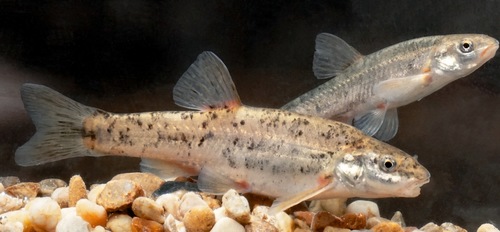
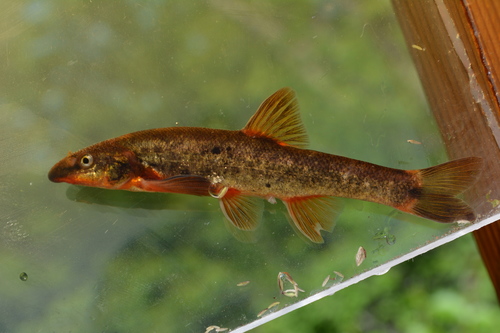
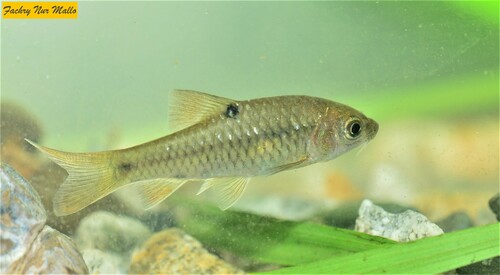
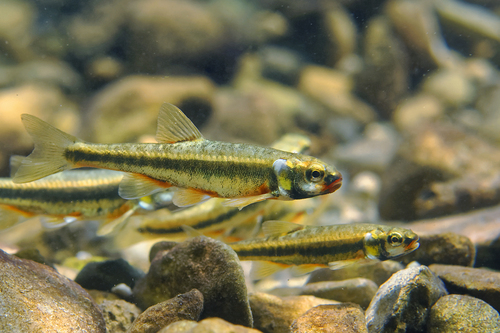
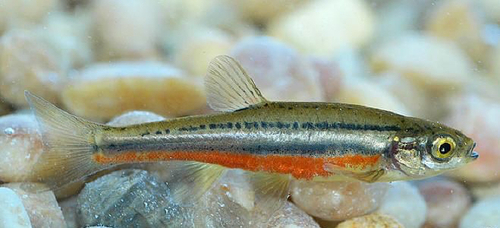
The northern redbelly dace, Chrosomus eos Cope, 1861, is a species of minnow that usually reaches roughly 55 mm in length. It has an iridescent silver back, with two dark longitudinal stripes running along its sides; the upper stripe often breaks into individual dots behind the dorsal fin. Its body is covered in small, nearly invisible scales. The lower sides of its body are typically white, yellow, or silver, but this area turns bright red on breeding males. Breeding females develop a distinct colorful green ventral stripe. Key identifying traits include a long coiling intestine and a black peritoneum, the membrane that lines the body cavity. Its lateral line is incomplete, and it has between 70 and 90 lateral line scales. All of its fins are made up of thin, flexible soft-rays, and are colored white, yellow, or silver. It has a pair of pectoral fins, plus pelvic fins located on the ventral abdomen, and has no adipose fin behind the dorsal fin on its back. Its caudal (tail) fin is notched and homocercal, meaning it has two symmetrical lobes. The northern redbelly dace occurs in a narrow, curved range stretching west from Nova Scotia and Prince Edward Island through southern Canada, and into the northern and north-central United States. In Canada, its range extends from Pennsylvania through Michigan and Wisconsin, north through Minnesota and northeast Iowa, to the Peace-Mackenzie drainage in British Columbia and the Northwest Territories. In the United States, it can be found in Maine, New Hampshire, New York, Pennsylvania, Michigan, Wisconsin, Minnesota, North Dakota, South Dakota, Nebraska, and Colorado. This species lives in cool, quiet, boggy streams and lakes. Suitable small stream habitats typically have water supplied by clear, cool springs or seeps, no strong currents, abundant cover such as undercut banks and dense brushy vegetation, and very few large predatory fish populations. Small lake habitats have similar characteristics: they are usually clear and spring-fed, have heavy shoreline vegetation, and hold few predatory fishes. In US states where the species is classified as vulnerable or endangered, it is only found in the extreme headwaters of clear streams and spring-fed seepage pools. These sites retain the cold water conditions that matched the glacially influenced landscape of the region 1,000 years ago. Human activity has reduced the extent of cold-water streams and seepage habitats, shrinking the amount of suitable area available for this northern species. Northern redbelly dace reach sexual maturity by their second or third summer, and can live up to eight years. Spawning starts in spring around May and continues into early August, and adult fish can spawn multiple times in a single season. Nonadhesive eggs are laid in filamentous algae, and hatch eight to ten days after laying at water temperatures between 21–27 °C.