About Chroogomphus vinicolor (Peck) O.K.Mill.
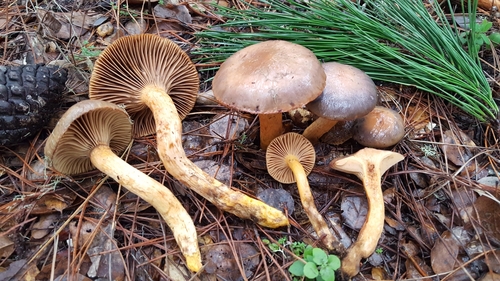
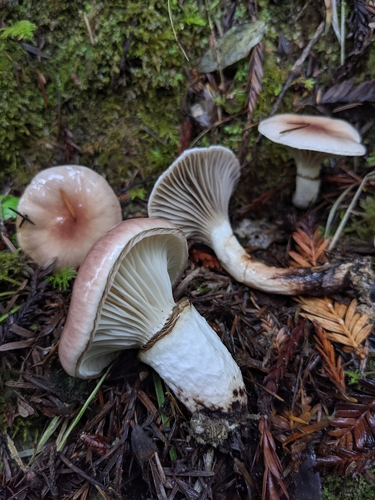
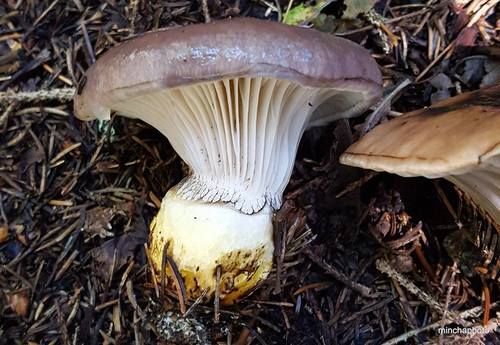
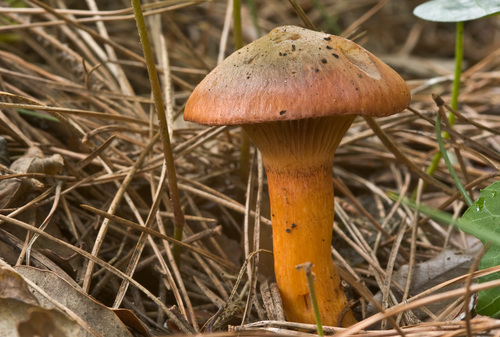
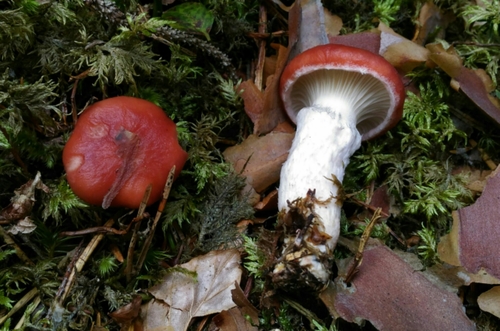
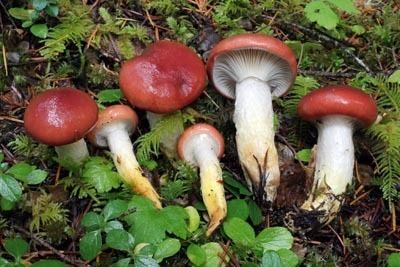
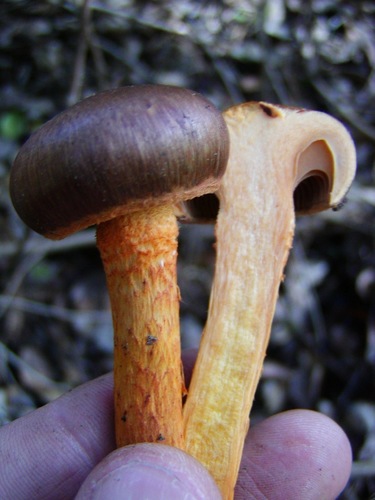
The fruit body of Chroogomphus vinicolor has caps that are first conical to convex, then flatten out as they mature, and sometimes develop either a small umbo or a central depression. Mature caps measure 2 to 10 cm (3⁄4 to 3+7⁄8 inches) wide. Cap color is highly variable, ranging from wine-red to reddish-brown, orange-brown, or yellow-brown. Wine-red stains form on areas of the cap surface that have dried or become rotten. The smooth cap surface is shiny, somewhat sticky when wet, and often radially streaked. The thick flesh is colored orangish to ochraceous; its taste and odor have been variously described as either "not distinctive" or "pleasant". The thick gills are decurrent, meaning they attach to the stem and extend a short way down its length. They are well spaced, ochraceous buff to pale orange when young, and turn blackish as spores mature. In his original description of the species, Peck noted that when viewed with a hand lens, the gills "appear velvety due to the abundant spores". Young fruit bodies are initially covered by a thin, web-like partial veil that disappears quickly as the cap expands. The cylindrical stem measures 2.5–15 cm (1–6 inches) long by 0.2–2 cm (1⁄8–3⁄4 inches) thick, tapers toward the base, and is colored ochraceous to wine red or reddish-brown, with a dry surface that is smooth to fibrillose. The partial veil sometimes leaves an indistinct, thin fibrous ring on the upper section of the stem. The spore print is greyish-black. Spores are narrowly elliptical to spindle-shaped, smooth, and measure 17–23 by 4.5–7.5 μm. Cystidia are somewhat spindle-shaped or narrowly club-shaped, measure 112–164 by 13–20 μm, and have characteristically thick walls, reaching up to 7.5 μm wide at their middle portion. C. vinicolor is a mycorrhizal fungus; it sometimes fruits singly, but more often produces fruit bodies scattered across or growing in groups on the ground under pines and other conifers. Fruiting usually happens during the cooler weather of late summer and autumn. However, in coastal California, fruiting occurs in winter. It is often found growing near Suillus luteus and S. brevipes, and is known to parasitize the mycelium of both of these species, as well as truffle-like Rhizopogon species. Chroogomphus vinicolor has a widespread distribution across North America, extending south into Mexico, and has also been recorded from the Dominican Republic. Although this mushroom is edible and often free of insect damage, it is not highly recommended for eating. It can be used as a filler mixed with more flavorful mushrooms, and its flavor may improve after drying. C. vinicolor mushrooms are sold in local markets in Tetela del Volcan, Morelos, Mexico. There is one recorded case of this species causing contact dermatitis: an individual who handled the mushroom developed a burning sensation in the eyes and an itchy rash on the eyelid after rubbing their eyes.