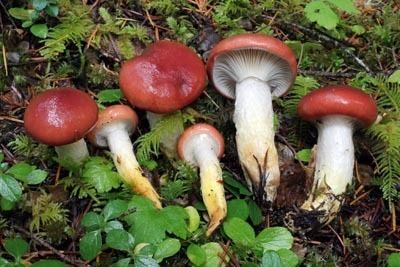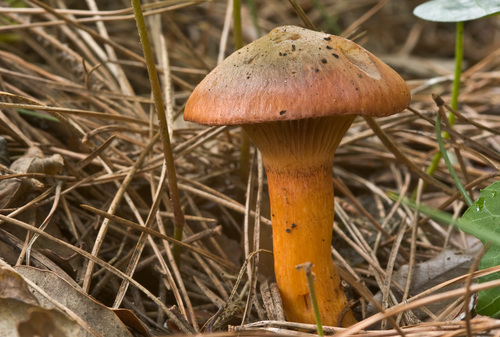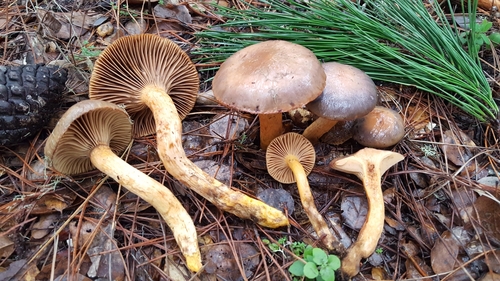
About Chroogomphus ochraceus (Kauffman) O.K.Mill.
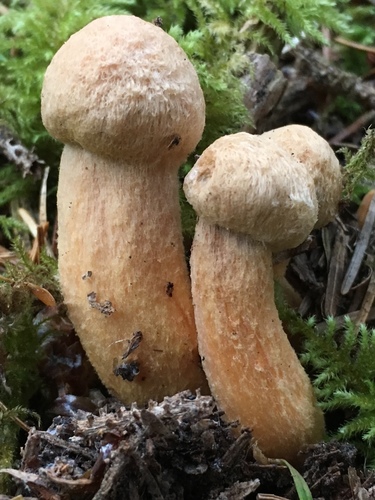
Members of the Chroogomphus genus are easily recognizable by their deep brown to apricot-orange coloration. When young, the cap (pileus) of Chroogomphus ochraceus has a conical shape. At maturity, it typically flattens into a flat, table-like shape, sometimes with a small depression at its center, and measures 2.5–9 centimeters (1–3+1⁄2 inches) across. The gills start as adnate before becoming decurrent, running from the cap edge all the way down the stipe, and grow thicker as they extend downward, a trait typical of other gilled boletes. The stipe is thicker at its base, does not bruise when cut, and has no distinctive scent. The spores of C. ochraceus are thin-walled, somewhat elliptical, and measure 15–24 × 5–8 μm. Its spore print is dark gray to black. This species is distributed across North America and Hispaniola, ranging north into Canada and south to Mexico. It produces fruit bodies throughout summer and early fall during cool weather, but can fruit through the winter in Coastal California. It fruits in small clusters. Originally, researchers assumed Chroogomphus species shared a mycorrhizal relationship with conifer trees, due to the genus’s close association with these trees. It is now understood that Chroogomphus are likely parasites of Suillus, a genus of boletes that are themselves associated with conifers.