About Chromolaichma sedna (Ev.Marcus & Er.Marcus, 1967)
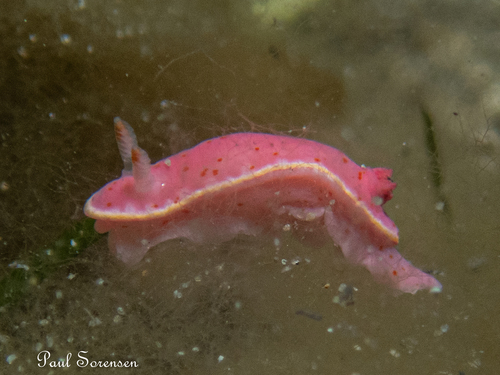
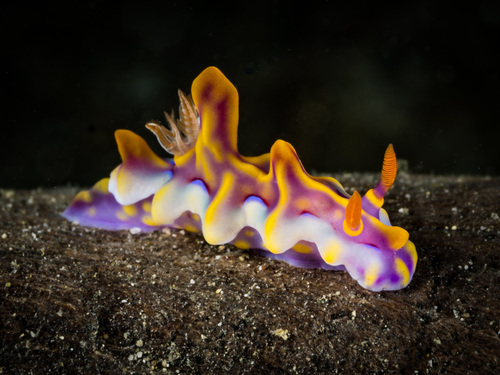
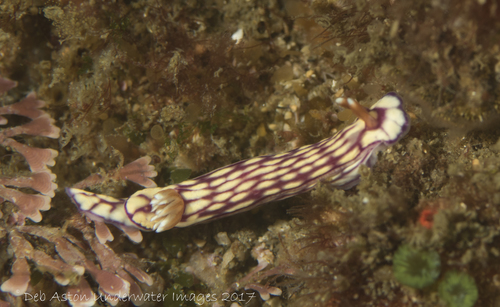
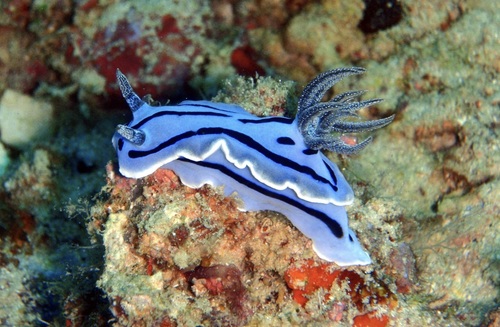
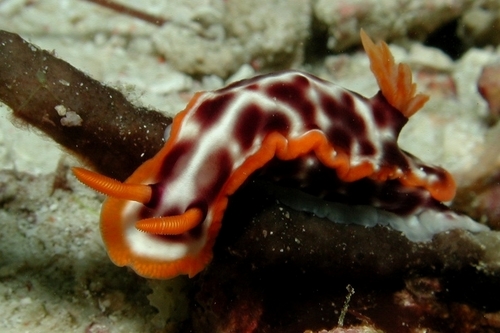
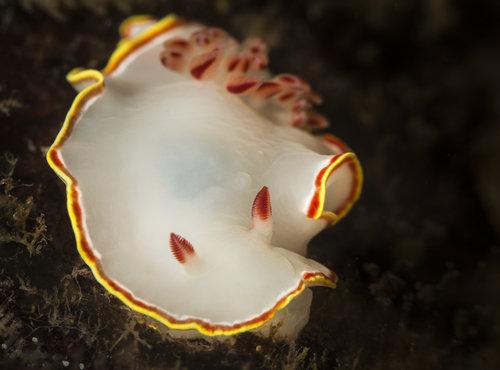
Chromolaichma sedna (Ev.Marcus & Er.Marcus, 1967) (also referenced as Doriprismatica sedna) is a species of seaslug. This seaslug has an oval body and a ruffled mantle margin. The foot and mantle have three distinct color bands along their outer borders, with a white base color, an inner red band, and an outer yellow band. The upper half of the rhinophoral clubs and the tips of the branchial leaves of the gill are red. Fully grown individuals can reach up to 65 mm in length. This species was originally described from the Eastern Pacific. Records of its presence in the Caribbean are considered to be the result of a recent, presumably human-mediated introduction. Its native distribution ranges from the Gulf of California to the Galapagos Islands in the Eastern Pacific. Non-native populations are found in the Western Atlantic, in Florida, Belize, Bahamas and Panama. In Panama, this species has been found on mangrove roots that are covered with sponges. Its recorded depth range spans from a minimum of 1 meter to a maximum of 29 meters. A 2010 study by Verdín Padilla et al. conducted on the Pacific coast of Mexico examined the stomach contents and feces of this species to investigate its diet. The study found that D. sedna feeds exclusively on spiculated demosponges, and has a variable diet that includes 17 different sponge species: Mycale psila, Microciona sp., Myxilla incrustans, Lissodendoryx isodictialis, Haliclona caerulea, Haliclona turquoisia, Callyspongia californica, Cliona californiana, Cliona amplicavata, Cliona flavifodina, Cliona papillae, Pione mazatlanensis, Pione carpenteri, Tethya taboga, Aaptos niger, Geodia media and Dysidea uriae.