About Chromodoris orientalis Rudman, 1983
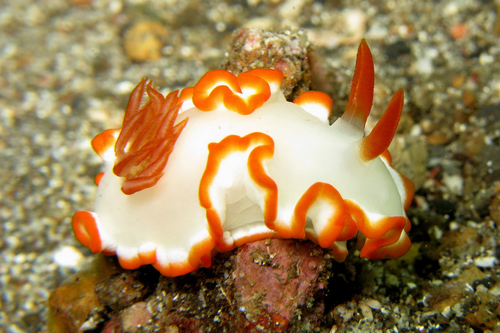
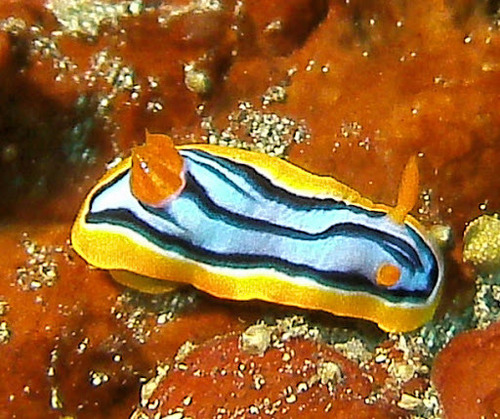
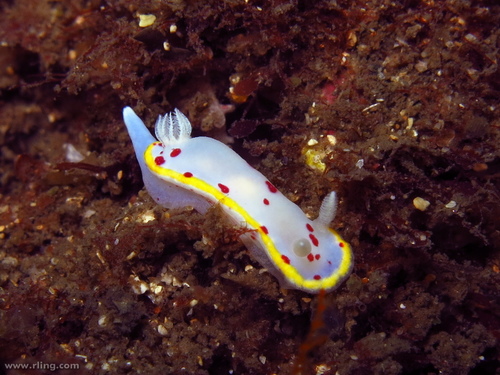
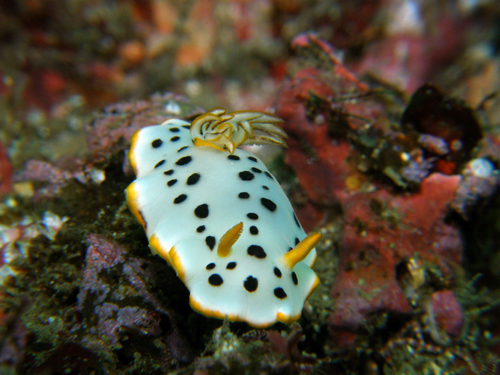
Chromodoris orientalis Rudman, 1983 has a translucent white mantle marked with oval black spots. The edge of its mantle has a narrow orange border, while its rhinophore clubs and outer gill surfaces are orange. Rhinophores are scent and taste receptors that protrude from the front of this sea slug, and gills protrude from the end opposite the rhinophores. Like other sea slugs, it has a muscular foot that serves as its main organ of locomotion, which it uses to crawl across different surfaces in the ocean. Its thick mantle covers the foot and acts as protection, secreting toxins for chemical defense. The maximum exact size and weight that this species can reach is unknown. This species has been reported from Japan, Hong Kong, and Korea. Chromodoris orientalis reproduces sexually, and like all nudibranchs, it is a simultaneous hermaphrodite, meaning each individual has both male and female reproductive organs at the same time. When mating, two individuals dart their penises at one another, and the first to penetrate becomes the dominant male. It lays eggs in "egg ribbons" that are attached along one edge. These egg ribbons are most commonly found on algae, though they can also be laid on rocks and other surfaces; very few studies have recorded this species laying eggs anywhere other than algae. Eggs are laid in whorls, and after hatching, individuals develop into vestigial veliger larvae before growing into mature adults. A study comparing egg size in this species with three other species in the genus Chromodoris found that egg size differs between species, but does not vary within a species based on the parental body length. The number of egg whorls also varies between species.