About Chromodoris magnifica (Quoy & Gaimard, 1832)
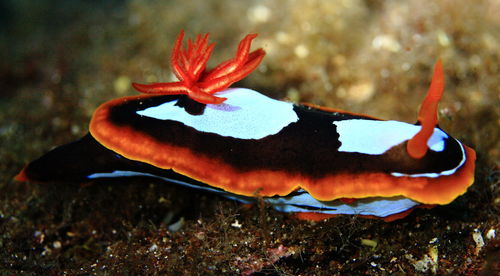
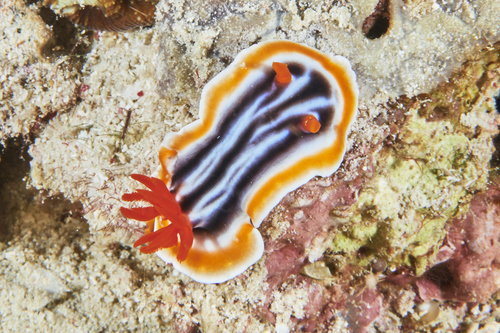
Chromodoris magnifica (Quoy & Gaimard, 1832) can reach a maximum length of 60 mm (2.4 in). It has an elongate body, with a foot that is separated from the upper body by a skirt-like mantle that partially hides the foot. Its branched gills and rhinophores are orange, and can be withdrawn into specialized pockets under the skin when the animal is threatened. The specific epithet magnifica means magnificent, chosen for this nudibranch's striking, vibrant coloration. The background body color is bluish white, with intensity that varies between individual specimens. On the mantle, the bluish area is outlined by two continuous black lines, and a third continuous median black line crosses this area. The bluish regions are often marked with dash-shaped black lines. The mantle edge is bordered by a wide white band that contains a central orange line; the width of these lines varies between individual specimens. The foot has three continuous longitudinal black lines, and shares the same bluish white background color as the mantle. The edge of the foot is outlined by an orange line and a white line. This species is easily confused with the closely similar Chromodoris quadricolor, but can be distinguished by its submarginal orange border. This nudibranch occurs in the central Indo-Pacific, ranging from Indonesia and the Philippines to New Guinea and Eastern Australia. Chromodoris magnifica feeds on sponges, and has been observed feeding specifically on red and grey sponges.