About Chromodoris elisabethina Bergh, 1877
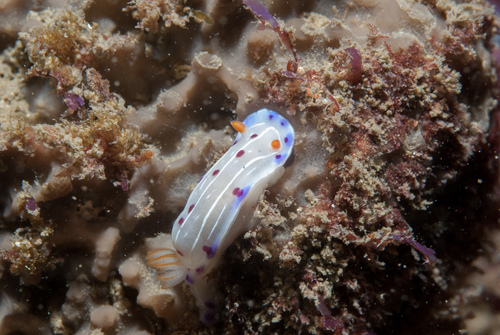
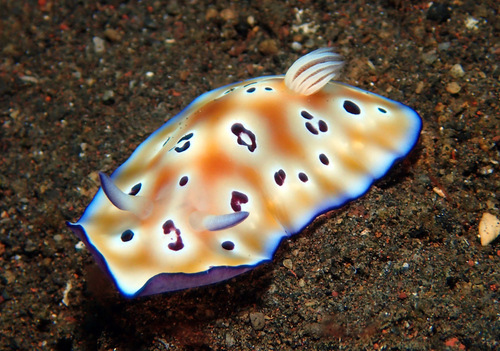
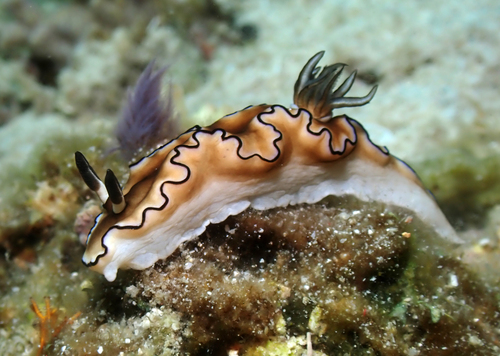
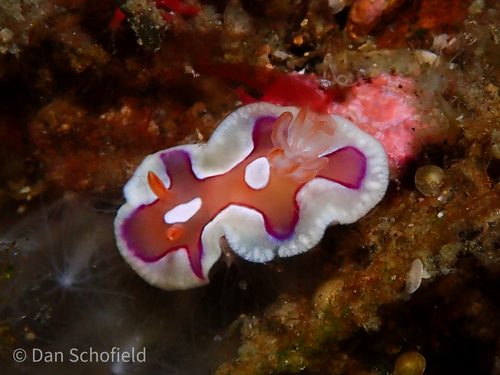
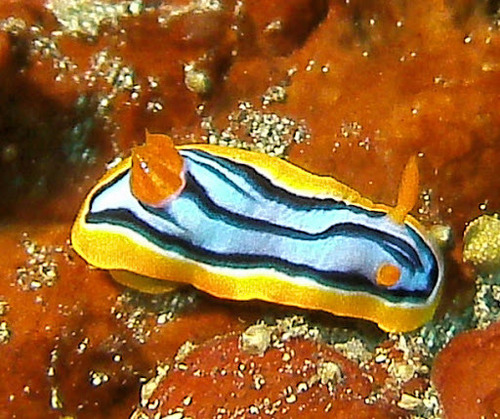
Chromodoris elisabethina can reach a maximum length of 50 mm (2.0 in). Its body is elongated, and the foot is separated from the upper body by a skirt-like mantle that partially hides the foot. Its branched gills and rhinophores range in color from orange to yellow, and can be withdrawn into pockets under the skin when the animal is in danger. The main body background color is blue, with intensity varying from blue-grey to deep blue. On the blue dorsal surface, there is a median black line that may be broken in some individuals, and usually several short, finer parallel lines. These longitudinal lines are also present on the foot. These discontinuous longitudinal lines are distinctive to this species, allowing observers to distinguish it from closely related species such as Chromodoris lochi, Chromodoris willani, and Chromodoris annae. The mantle edge and foot are edged with white and orange-to-yellow lines, whose width and color intensity vary greatly between individual specimens. A black line outlines the blue body and its external margin. A recent molecular phylogeny study has confirmed that Chromodoris elisabethina is a species complex. This species was first described from Burias Island, Philippines. It occurs in the central Indo-Pacific, ranging from Malaysia, Indonesia, the Philippines, and Queensland, Australia to southern Japan.