About Chromodoris annae Bergh, 1877
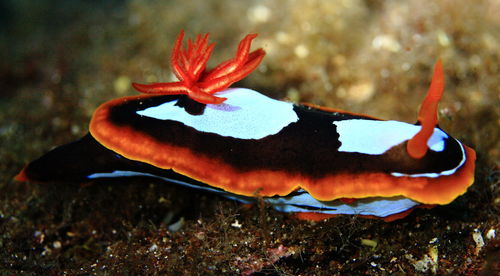
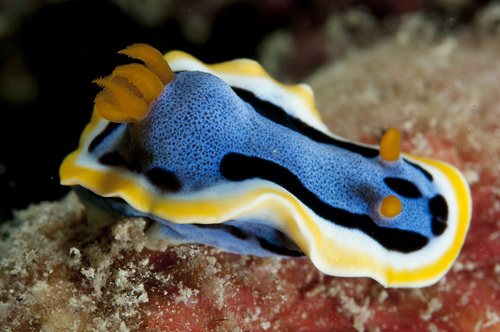
Chromodoris annae can reach a maximum total length of 5 cm (2.0 in). It has an elongated body, with a skirt-like mantle that separates the foot from the upper body and partially covers the foot. Its branched gills and rhinophores range in color from orange to yellow. The main body color comes in various blue shades, varying in intensity from blue-grey to deep blue, with faint speckling of tiny black spots. A black line borders the blue dorsal side and the foot, and this line may be discontinuous in some specimens. A small black dash between the rhinophores sets this species apart from similar species like Chromodoris elisabethina and C. westraliensis. Both the mantle edge and the foot are bordered by white and orange-to-yellow lines, whose width and color intensity vary widely between individual specimens. This nudibranch species occurs in the central Indo-Pacific, ranging from Malaysia, Indonesia, and the Philippines to the Marshall Islands. The central Indo-Pacific is a biodiverse tropical region made up of shallow waters and extensive coastal shorelines, with abundant coral reefs, mangroves, and seagrasses. During the day, Chromodoris annae is typically found alone on coral reefs, and it occurs at depths between 15 and 30 m (49 to 98 ft). The diet of Chromodoris annae consists exclusively of sponges from the single genus Petrosaspongia. These sponges are toxic to other potential predators, and Chromodoris annae is able to absorb the toxic compounds from the sponges and store them in glands that run around its mantle. The stored chemicals are unappealing to local fish, which helps Chromodoris annae avoid being preyed upon. Along with this toxin sequestration, it is thought that the bright, vibrant coloration of Chromodoris annae may be aposematic, acting as a visual deterrent to predators. At present, the only known predators of Chromodoris annae and other species in the genus Chromodoris are nudibranchs from the carnivorous genus Gymnodoris. Chromodoris annae is a planar spawning species, which means it lays flat, two-dimensional egg masses. It deposits its egg masses in a spiral arrangement that starts at the center and extends outward. While the individual eggs are somewhat translucent, the ova are cream-colored, which gives the entire egg mass a faint cream tint. Each egg mass typically has around 3 to 4 spiral whorls.