About Chromobotia macracanthus (Bleeker, 1852)
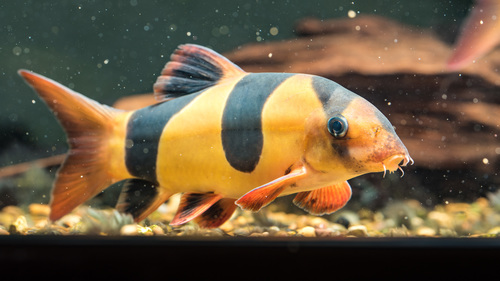
Estimates for the maximum size of the clown loach (Chromobotia macracanthus) vary, with some sources putting the maximum at 20–30 cm (7.9–11.8 in), while typical adults reach 15–20 cm (5.9–7.9 in). The species has a long, laterally compressed body, with an arched dorsal surface and a flat ventral surface. Its head is relatively large, with a downward-facing mouth that has thick, fleshy lips and four pairs of barbels; the barbels on the lower jaw are small and hard to see. Clown loaches can produce clicking sounds when content, acting territorially (as a warning signal), or mating. This sound is created by grinding their pharyngeal teeth. Their body base colour ranges from whitish-orange to reddish-orange, marked with three thick, black, triangular vertical bands. The frontmost band runs from the top of the head through the eye, the middle band sits between the head and the dorsal fin and wraps around to the ventral surface, and the rearmost band covers almost the entire caudal peduncle and extends to the anal fin. There is regional colour variation within the species: clown loaches from Borneo have reddish-orange and black pelvic fins, while those from Sumatra have entirely reddish-orange pelvic fins. The species is sexually dimorphic: females are slightly plumper than males, and males have tail tips that curve slightly inwards, while females have straight tail tips. Clown loaches have a movable spine located in a groove below the eye, which can be extended for defense. The spine can cause a painful wound, but it is not venomous. It can also act as a tool for capturing prey, since it sits close to the mouth. Clown loaches are native to the Indonesian islands of Sumatra and Borneo. Their optimal habitat is clear stream environments, but biannual monsoon flooding forces them to move into flooded floodplains, or murky or blackwater rivers or lakes, for 7 to 8 months of the year. They are commonly found in the floodplains of hilly areas. Mature breeding individuals migrate to smaller waterways to spawn each year. In their native habitat, they occur in water with temperatures between 25 to 30 °C (77 to 86 °F), a pH between 5.0 and 8.0, and a water hardness between 5 and 12 dH. In captivity, clown loaches only reproduce after hormonal stimulation triggers final oocyte maturation and ovulation. Captive breeding and mass production of clown loaches is primarily carried out in Indonesia (the species' country of origin) and in Europe.