About Chromis chromis (Linnaeus, 1758)
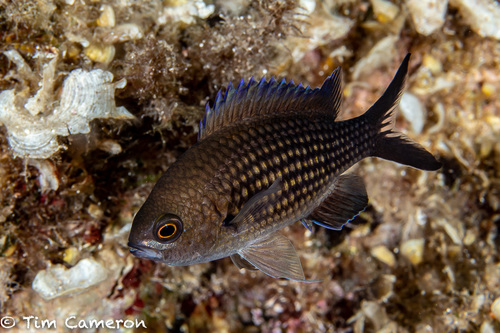
Chromis chromis (Linnaeus, 1758) has an oval, laterally compressed body with a noticeably large eye. Its mouth is strongly protractile, extending to below the center of the eye, with small canine-like teeth arranged in 3 rows on the jaws. The preoperculum is not serrated, and the anterior gill arch holds 30 slender gill rakers. The dorsal fin has 13–14 spines and 10–11 soft rays, while the anal fin has 11 spines and 10–12 soft rays. The entire body, including the head, is covered in large scales, and there are 24–30 scales along the lateral line. There is a single pair of nostrils.
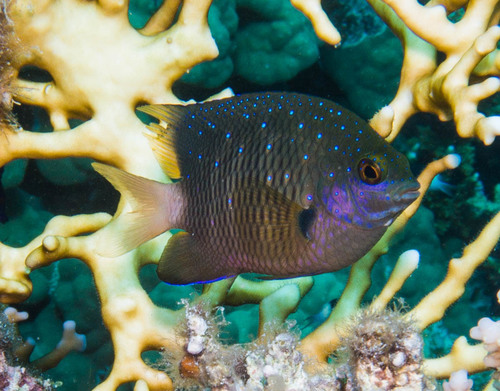
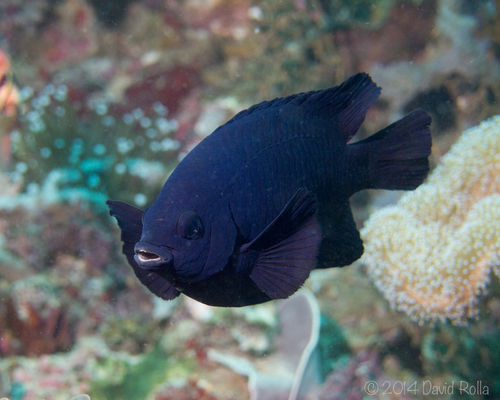
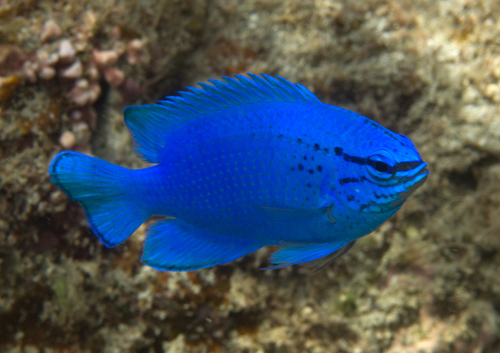
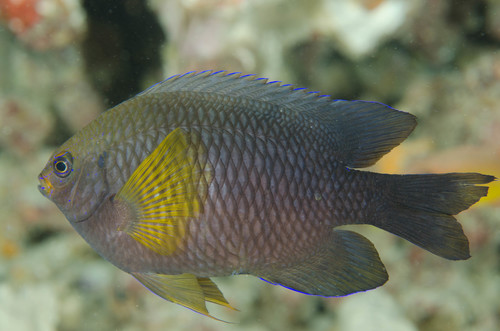
Young Chromis chromis are a striking iridescent blue. Older juveniles have blue stripes, with blue outlines along the dorsal and anal fins. Adults are dark brown, with the center of each scale colored a paler golden brown or grey-brown; the edge of the caudal fin lacks any dark color, particularly at the center of the fin fork. Breeding males turn a vivid pale violet. This species reaches a maximum total length of 25 centimetres (9.8 in), with a more common adult length of 13 centimetres (5.1 in).
This species is found in the Black Sea, Mediterranean Sea, and eastern Atlantic Ocean, ranging from Portugal to Angola. This range includes the Macaronesian Islands and the Gulf of Guinea Islands, and it is generally more common around islands than along mainland coasts. It is uncommon in both the Black Sea and the Sea of Marmara. Chromis chromis lives in littoral zones, most often in rocky habitats between 2 and 40 metres (6.6 to 131.2 ft) deep. It forms small shoals that swim in midwater above or near rocky reefs, and above seagrass meadows.
Spawning takes place in summer, with timing varying by location. Males and females pair up and perform courtship behavior, before laying eggs in a nest built on rocky, or sometimes sandy, substrate. The eggs stick to the substrate, and are guarded by the male. A single female can lay between 6,050 and 73,688 eggs per clutch.