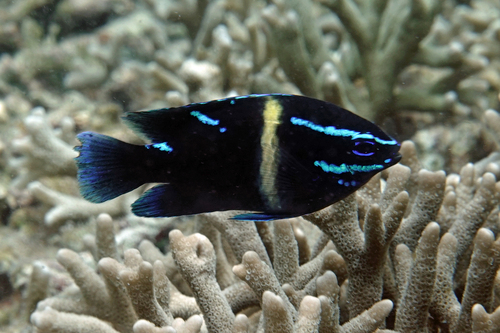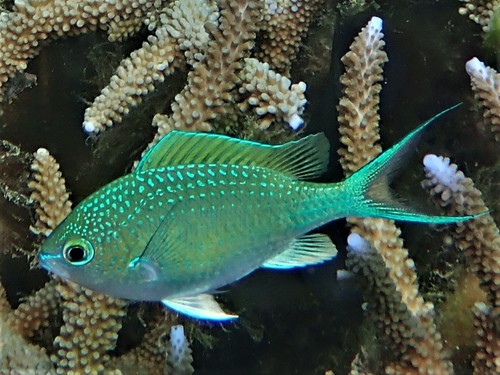
About Chromis atripectoralis Welander & Schultz, 1951
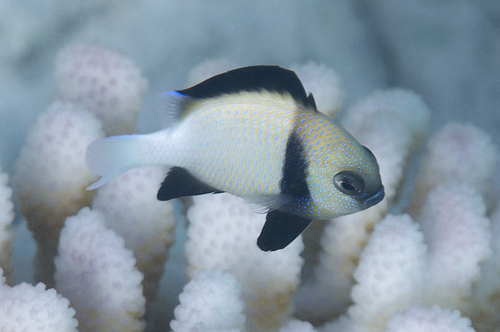
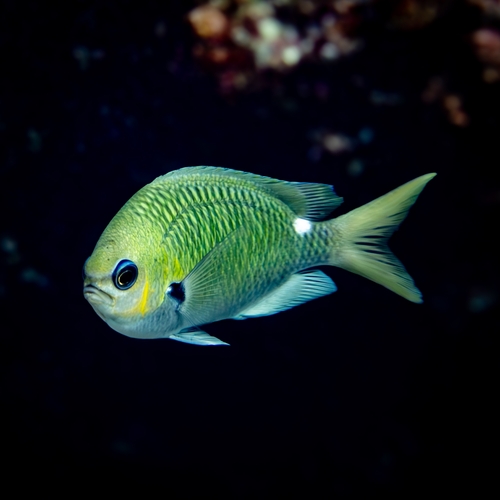
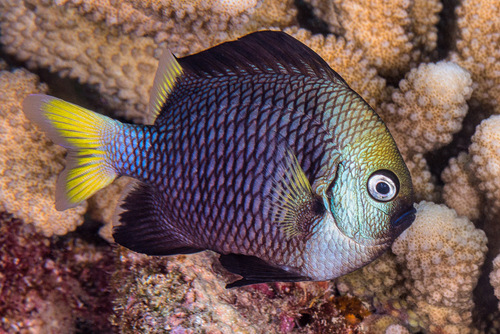
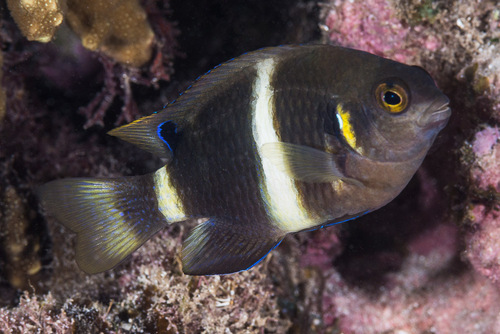
Chromis atripectoralis Welander & Schultz, 1951, commonly called the blue-green damselfish, reaches a maximum total length of 12 centimeters. Its head and dorsal side are blue-green, while its belly ranges from white to off-white gray. This species has two rows (inner and outer) of widely spaced, conical teeth. It is the confirmed sibling species of the similar blue-green damselfish Chromis viridis based on mitochondrial genome analysis, and the two are frequently confused due to their matching body shape and blue-green coloration. They can be distinguished by fin color patterns: the axil (base crevice) of the pectoral fin is solid black in C. atripectoralis, while the upper pectoral fin base of C. viridis looks dusky from scattered black dots. The two sibling species also have different, though overlapping, counts of pectoral fin rays: C. atripectoralis has 18 to 20 pectoral rays, compared to 17 to 19 in C. viridis. The geographic range of C. atripectoralis covers the Indian and South Pacific Oceans, extending from the east African coast east to French Polynesia, and north to the Ryukyu Islands of Japan in the North Pacific. Its habitat range overlaps fully with that of its sibling C. viridis, though C. viridis is also found in the Red Sea, an area outside C. atripectoralis’ range. All life stages of C. atripectoralis live on coral reefs, with adult individuals showing a preference for branching corals, but also occurring in plate, submassive, massive, encrusting, soft, and dead corals; adults may also occupy reef rubble or consolidated pavement. Juveniles prefer branching and plate corals, and have also been recorded in submassive corals, only living on consolidated pavement. C. atripectoralis is highly specialized to coral reef habitats, so population declines are linked to the loss of coral reef niche space. Compared to co-occurring cardinalfish, this damselfish tolerates higher water temperatures. Between 29 °C and 33 °C, its aerobic scope does decrease, but it still maintains an aerobic respiration rate greater than half of its normal scope at maximum temperatures in this range. This relatively high thermotolerance may let the species survive at latitudes closer to the equator, and help it avoid extinction as global ocean temperatures rise.