About Chroicocephalus serranus (Tschudi, 1844)
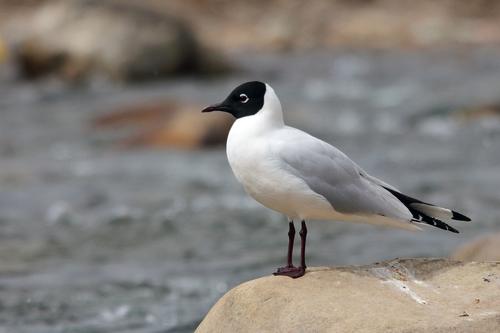
Chroicocephalus serranus (Tschudi, 1844), commonly called the Andean gull, measures 42 to 48 cm (17 to 19 in) in length and weighs approximately 480 g (17 oz). It is one of the larger species in its genus, and males and females have identical appearance. Adults in breeding plumage have a glossy black hood with a white crescent behind the eye, a mostly white body, a gray back, and sometimes a pink tint on the underparts. Their tail is white. The upper surface of the wing is mostly gray, with an alternating white-black-white-black pattern on the primary flight feathers. The underside of the wing is pale gray, with a blackish outer half that features large white "mirror" markings on the three outermost primaries. The bird's bill, legs, and feet are blackish brown with a reddish tinge, and its iris is brown. Non-breeding adult Andean gulls have a white head and blackish legs. The species takes two years to reach full adult plumage. In its first year, it has some mottled black markings on the head, a complex black and white pattern on the wings, and a black band near the tip of the tail. The Andean gull lives year-round in the Andes, from far southwestern Colombia south through central Ecuador, Peru, western Bolivia, eastern Chile, and western Argentina, reaching approximately the latitude of the northern part of Chile's Aysén Region. Many individuals spend the winter on the coast from central Peru south into northern Chile, but it is unknown whether these wintering birds come from the Andean highlands east of the coast or from the southern portion of the species' range. The Andean gull has been recorded as a vagrant in Amazonian Peru and far southern Argentina. During its breeding season, the Andean gull inhabits lakes, bogs, marshes, and fields in the puna and páramo zones of the Altiplano. In this breeding habitat, it most commonly occurs at elevations between 3,000 and 5,300 m (9,800 and 17,400 ft), though it can be found as low as 1,200 m (3,900 ft) in the southern part of its range. Wintering Andean gulls are typically found at river mouths and sand beaches along the coast.