About Chroicocephalus ridibundus (Linnaeus, 1766)
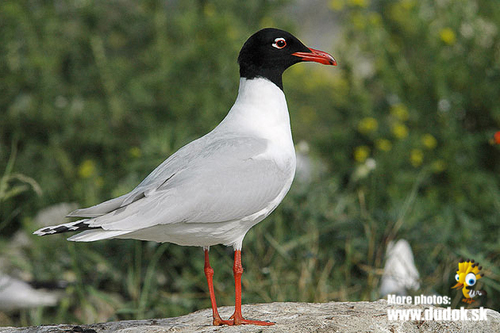
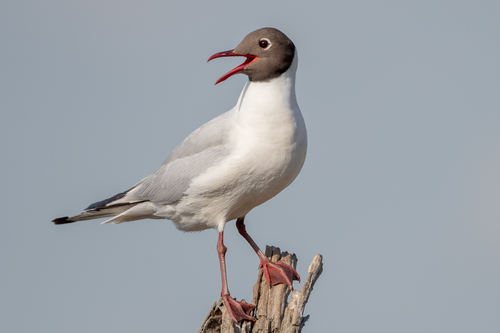
This gull measures 34–39 cm (13+1⁄2–15+1⁄2 in) in length, has a 100–110 cm (39+1⁄2–43+1⁄2 in) wingspan, and weighs 166–400 g (5+7⁄8–14+1⁄8 oz). On average, males are heavier than females, weighing 186–400 g compared to females' 166–350 g, though there is considerable overlap in weight between the sexes. When in flight, the white leading edge of the outer wing (the outer primaries) is a reliable identifying field mark, especially when combined with the dark underside of the inner primaries. This combination distinguishes the species from its close relative Bonaparte's gull, which has a white underside to these feathers. A summer adult has a chocolate-brown head (which appears black from a distance, though it is not actually black), with a white neck, white underparts, white tail, pale grey wings and back, black tips on the primary wing feathers, and a red bill and red legs. Adults lose their brown hood in winter, retaining only two dark spots located above and behind the eye. Summer plumage is held from March to July, rarely starting as early as late January and lasting into August; winter plumage is held from late July until March or April. Black-headed gulls take two years to reach full maturity. Juvenile birds, for the first one to two months after fledging, have a mottled pattern of brown spots across most of their body, and a black band on the tail. In late summer, juveniles moult into first-winter plumage, which has a grey back but retains a brown carpal bar on the inner wing, blackish secondary feathers, and the black tail band. In their first summer (when one year old), they develop a partial brown hood; the extent of this hood varies widely between individuals, from almost no brown on the head to a full hood matching that of an adult. Second winter plumage matches adult plumage, except for occasional brown marks on the wings and tail tip in some individuals. There is no difference in plumage between males and females. The species breeds in colonies located in large reed beds, marshes, or on islands within lakes, and nests on the ground. Colonies can range from just a few pairs (or even a single pair) up to several thousand pairs, and exceptionally can hold over 10,000 pairs. Like most gulls, black-headed gulls are highly gregarious during winter, both when feeding and when gathering at evening roosts. This is not a pelagic species, and it is rarely seen at sea far from coasts. Like most gulls, black-headed gulls are long-lived, with a maximum recorded age of at least 32.9 years for individuals in the wild. Black-headed gulls breed across the Palearctic, covering most of Europe and northern Asia, from Iceland and Ireland east to Japan and eastern China. The species is abundant, with a total global population of 2–3 million pairs. It is most numerous in Europe, with the largest concentrations being up to 300,000 pairs in Great Britain and 250,000 pairs in Poland. The species' range is slowly expanding westwards: it first colonized Iceland in 1911, Greenland in 1969, and Newfoundland in Canada in 1977. By the late 20th century, around 20 pairs bred in northeastern Canada. Black-headed gulls migrate south and west away from regions that experience severe winter freezing, reaching northern Africa and southern Asia, with small numbers traveling as far south as the Equator. Areas within the breeding range that have milder winters, such as Great Britain, receive large influxes of migrants from colder areas including Scandinavia, Poland, the Baltic States, and Russia; the British winter population is around 3 million. Small numbers of black-headed gulls spend winter in northeast North America as far south as Virginia, often joining flocks of the similar-looking Bonaparte's gull. The eggs of the black-headed gull were considered a delicacy by some people in the UK, and were eaten hard boiled. Collection of black-headed gull eggs is heavily regulated by the UK government. Only a small number of licensed people may collect eggs at six sites, between 1 April and 15 May each year, and only one egg may be taken from each nest. No eggs are permitted to be sold after 30 June. Since black-headed gulls tend to lay their eggs in late April and early May, the eggs are only available to purchase for 3 or 4 weeks each year.