About Chroicocephalus maculipennis (M.H.K.Lichtenstein, 1823)
Chroicocephalus maculipennis was first described by M. H. K. Lichtenstein in 1823.
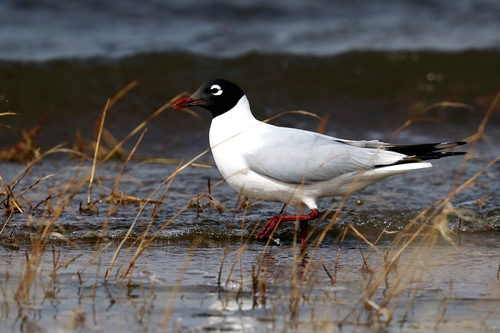
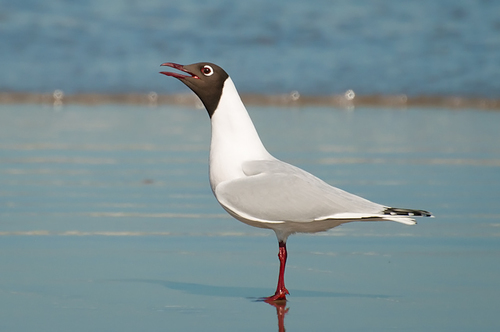
Description: Breeding-season adults have a dark brown head and throat, with a white semicircle around the back of the eye. Their neck, chest, and abdomen are white. In winter plumage, most of the brown head marking is lost, with only a dark spot behind the eye and a dark smudge around the eye remaining. This species has red beak and legs, and dark brown eyes. The outer primary flight feathers are white with black tips (the 'spots' referenced in its scientific name) when viewed from above, and show more extensive black coloration when viewed from below. The inner primaries, secondaries, and covert feathers are silvery grey. There is no notable sexual dimorphism between adults. Juvenile birds are distinct from adults: they have pale brown mottled wings, a black bar at the tip of the tail, paler orange-red legs, and an orange-red bill with a dark tip. Because its plumage is very similar to that of the closely related black-headed gull C. ridibundus, some authors have previously classified it as a subspecies of C. ridibundus. It is now universally recognized as a separate species, and the two species do not have overlapping ranges.
Distribution and habitat: This gull species is found in South America. It breeds in Patagonia (Argentina and Chile), the Falkland Islands, and Uruguay. In winter, its range extends north to the coasts of northern Chile and central Brazil. Its natural habitats include freshwater lakes, intertidal marshes, river banks, and open fields. The total global population is estimated at around 50,000 to 100,000 breeding pairs. It is most abundant in central Chile and eastern Argentina, while the Falkland Islands has a small population of only around 600 pairs.
Ecology and behaviour: Chroicocephalus maculipennis is a gregarious bird. Its diet consists mainly of insects, carrion, and food obtained by kleptoparasitism (stealing food) from other birds. Specifically, it steals crabs from red-gartered coots (Fulica armillata) and clams from American oystercatchers (Haematopus palliatus). Stealing from red-gartered coots is 3.5 times more energetically profitable than stealing from American oystercatchers. This species builds floating nests among aquatic vegetation at the edges of ponds and lakes. Clutches usually contain three to four eggs.