About Chroicocephalus cirrocephalus (Vieillot, 1818)
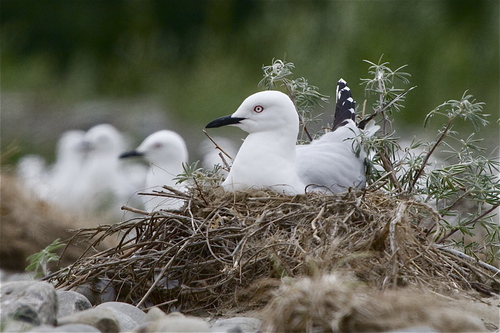
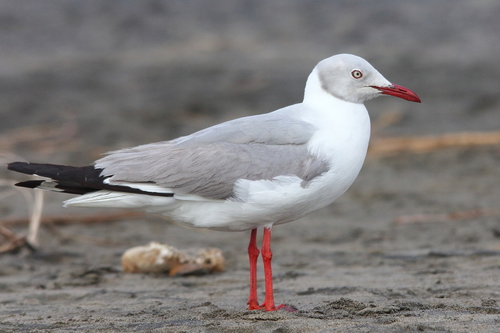
The grey-headed gull (Chroicocephalus cirrocephalus) measures 42 cm in length, making it slightly larger than the black-headed gull. In summer, breeding adults have a pale grey head, a grey body that is slightly darker in tone than the body of the black-headed gull, and red bill and legs. The black tips of its primary wing feathers have prominent white "mirrors", and its underwing is dark grey with black wingtips. Adults lose their grey hood in winter, retaining only two dark smudges around and behind the eye. Immature grey-headed gulls have dark eyes, while adults have a white iris. The sexes have similar appearance. This species takes two years to reach maturity. First year birds have a black terminal band on the tail and more dark areas on the wings. When in flight, the grey-headed gull has broader wings than the black-headed gull. It is a noisy species, particularly when at colonies, and its call is a raucous crow-like caw, caw. The grey-headed gull is locally abundant, and breeds in large colonies in reedbeds and marshes. It lays two or three eggs in a nest that may be built on the ground or float on water. Like most gulls, it is highly gregarious during winter, both when feeding and gathering in evening roosts. While it is predominantly found in coastal or estuarine areas, it is not a pelagic species, and is rarely seen at sea far from land. When feeding conditions are favorable, flocks numbering hundreds or thousands of grey-headed gulls can form.