About Christinus marmoratus (Gray, 1845)
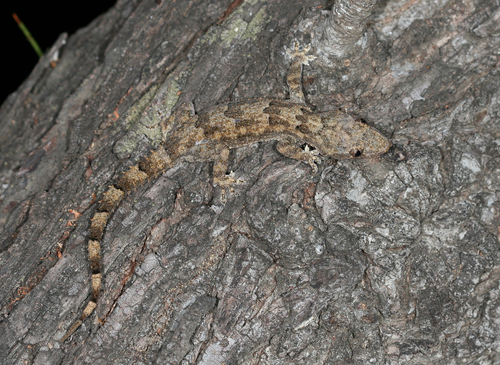
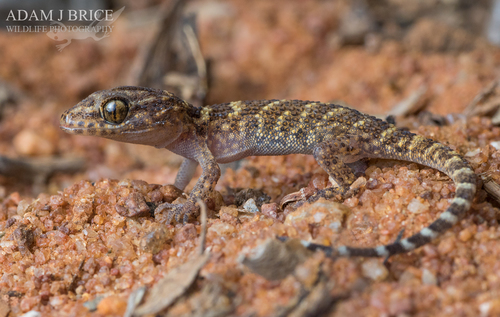
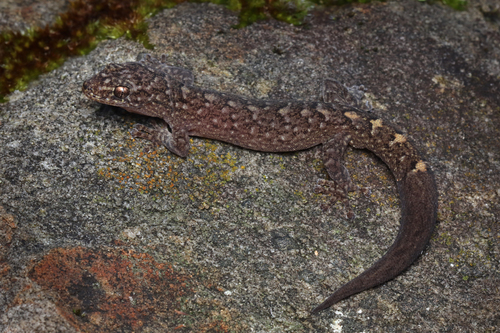
Adults of Christinus marmoratus reach an average snout-vent length of 50 mm, and weigh approximately 2.5 grams. This species stores fat reserves in its tail, which can be shed from the body through autotomy when the gecko is threatened, to help it escape. Tails take around eight months to regenerate. Fully regenerated tails have a distinct abrupt change in dorsal skin color and pattern at the level of the original fracture plane. Original tails also have much more developed muscular bands than regenerated tails. Hatchlings of C. marmoratus have no fat stored in their tails, and they shed their tails more readily than adult geckos do. C. marmoratus is Australia’s most southerly gecko. Its range extends from northeastern New South Wales to southwestern Western Australia, and it also occurs on a number of islands off the coasts of South Australia and Western Australia. It occupies a wide variety of habitats, including open shrubland, sclerophyll forest, riverine woodland, and urban regions. C. marmoratus is an insectivorous, nocturnal species. During hot summer months, it typically uses deep crevices and burrows as daytime retreat sites; in cooler weather, individuals aggregate under rocks. Riverine populations of C. marmoratus usually rest during the day under the thick, exfoliating bark of large eucalyptus trees. C. marmoratus is commonly found in aggregations of up to 10 individuals, and most aggregations include one male. Since many gecko species are documented to exhibit territorial behaviour, the common aggregating behaviour of C. marmoratus is considered surprising; Kearney et al. reported that one quarter of all individuals they located were found in aggregations. It has been hypothesised that this behaviour may be linked to higher mating success, increased predator vigilance, or simply that individuals are attracted to high-quality habitat. In 1998, Angiletta and Werner found that the preferred body temperature of C. marmoratus is 27.7 °C, which is much higher than the species’ average body temperature during either the day or night. A 2000 study by Kearney and Predavec found that C. marmoratus may thermoregulate by adjusting its posture, for example by raising or flattening its body to change contact with the rock substrate. Individuals also appear to touch the rock with their snout before adjusting posture, as if testing the rock’s temperature. C. marmoratus rarely vocalises; when it does make sound, it is usually a squeaking call produced in response to an attack.