About Choromytilus meridionalis (Krauss, 1848)
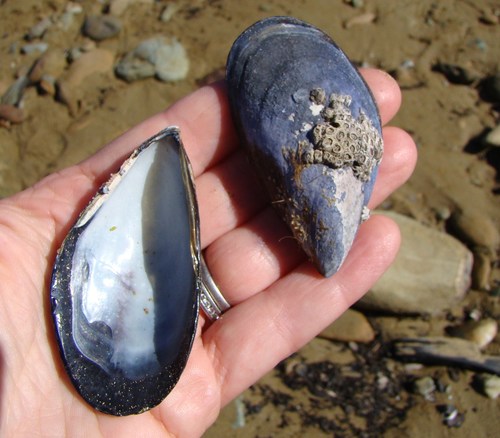
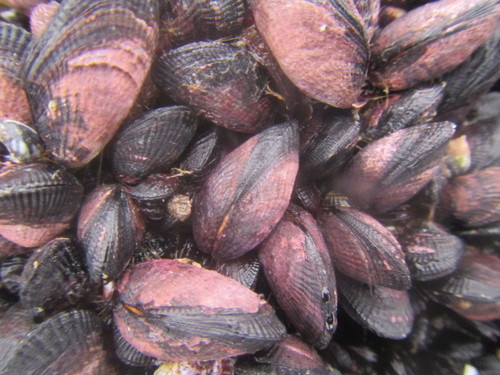
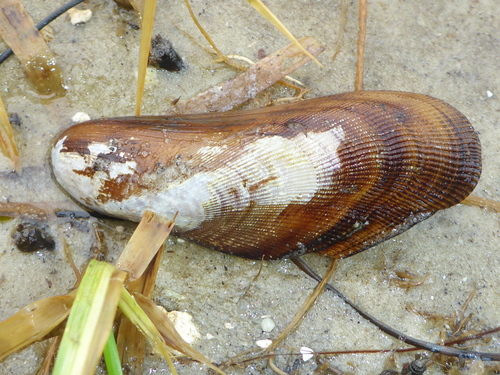
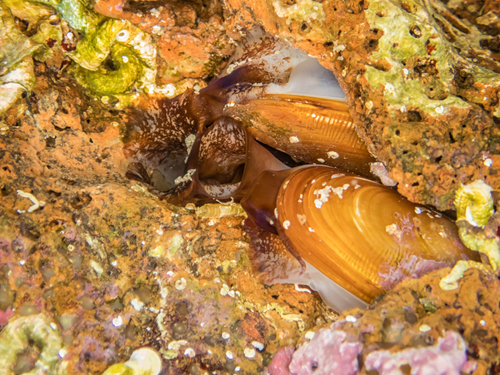
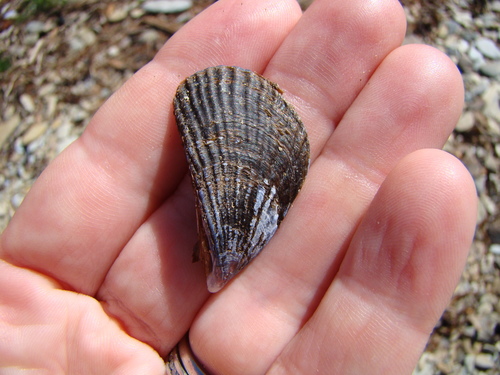
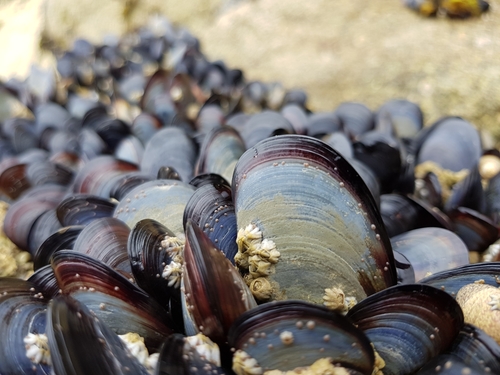
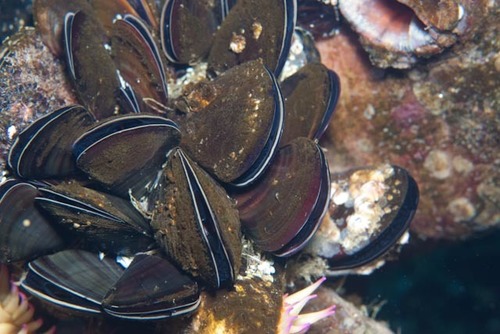
Choromytilus meridionalis, commonly known as the black mussel, reaches a maximum length of 150 mm. This species is a shiny black mussel that grows in clustered groups on rocks and in sandy areas. It is narrower and darker black than the Mediterranean mussel Mytilus galloprovincialis, a species it is often confused with. It belongs to the family Mytilidae, a group defined by narrow, elliptical, fan-shaped, thin, equally sized valves, a lack of prominent hinge teeth, and byssal threads extending from the hinge area to anchor the organism to rigid substrates. C. meridionalis occurs in multiple marine and brackish habitats, including lagoons, coasts, the inner and outer continental shelf, open ocean, brackish water, and full seawater. It is endemic to the southern African coast, ranging from central Namibia to Port Elizabeth, where it lives in the sublittoral and lower littoral zones of rocky areas. Population density of this species varies significantly across tidal levels, with the highest densities occurring at the mid-tidal level. Tidal levels also affect growth rates: C. meridionalis individuals at mid-tidal levels show the highest growth rates. The key environmental factors shaping the species' distribution are temperature and sediment type; it thrives in temperatures between 12.5 and 30 °C, while salinity has little effect on its distribution or abundance. The black mussel is a filter feeder that consumes floating fragments of algae and phytoplankton. Particulate organic matter is the main food source for many filter-feeding bivalves, including C. meridionalis. This species uses bacteria as a nitrogen resource, which is critical to its growth and survival in the intertidal zone. Bacterial nitrogen uptake by C. meridionalis is highest at high tide and lowest at low tide. This uptake is also influenced by the availability of other nitrogen sources such as dissolved inorganic nitrogen, meaning the species can adjust its nitrogen uptake strategy based on how much of each nitrogen source is available. C. meridionalis may coexist in the field with another bivalve, Aulacomya ater. In the False Bay region of southern Africa, all mature C. meridionalis individuals reproduce synchronously, with two separate breeding seasons each year. While the total number of eggs and sperm released annually varies between years, the ratio of eggs to sperm remains constant. This species has separate sexes: females can be identified by the chocolate-brown color of their ovary, while the testis ranges from yellow to white depending on its developmental stage. In mature individuals, the gonad forms a thickened lobe along the midline between the gills, posterior to the foot. Gametogenesis (the production of gametes) occurs continuously throughout the year in C. meridionalis. Larvae of this species are present in the water column most of the time, and they readily settle on ropes or buoys suspended in the water; they rarely settle on natural rocky substrates.