About Choriaster granulatus Lütken, 1869
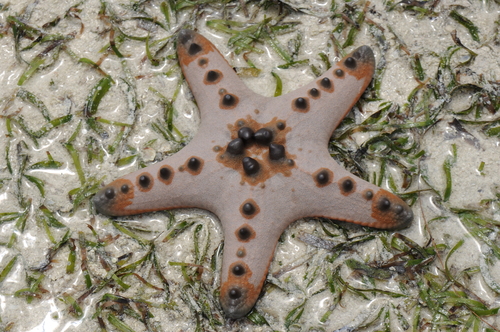
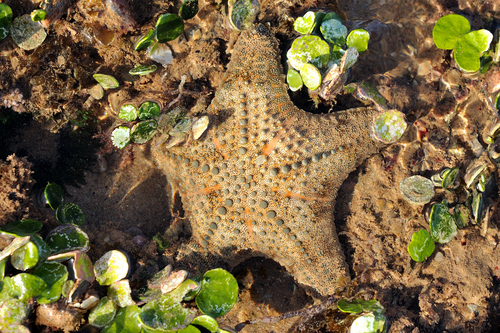
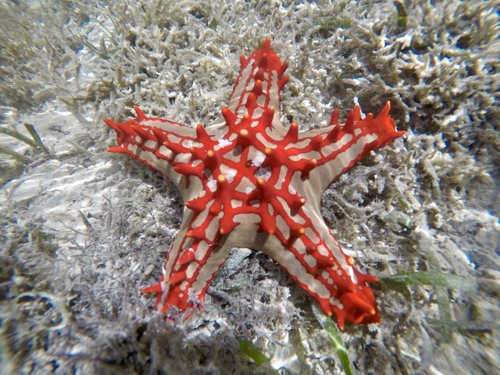
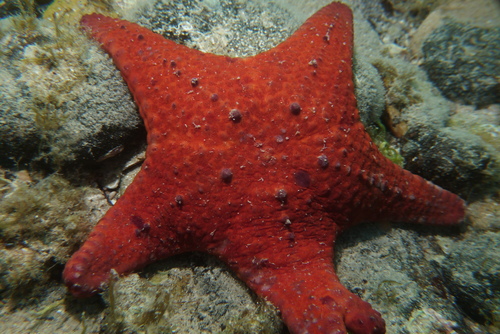
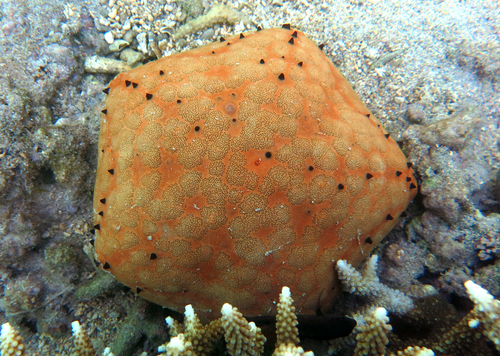
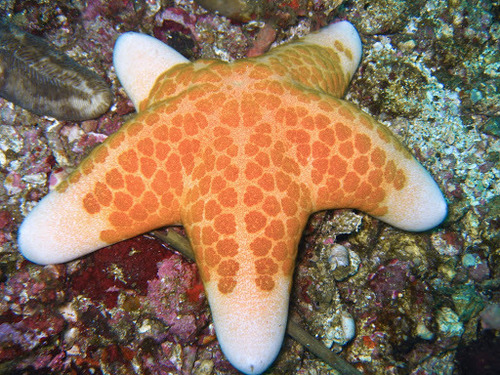
Choriaster granulatus has a convex body and five short arms with rounded tips. It is relatively large compared to other sea stars, reaching a maximum radius of around 27 cm (11 in). Its most common coloration is pale pink, with brown papillae radiating out from the center; it can also appear in colors ranging from grey to yellow, and even red. This sea star occurs individually or in groups on coral reefs across the Indo-West Pacific region, stretching from East Africa all the way to Fiji. It has been recorded in the Indian Ocean, the Red Sea, and the Great Barrier Reef. It most often inhabits sandy areas with rubble slopes and detritus, but can also be found living among corals and sea sponges. It prefers shallow waters between 1.5 to 53 m (5 to 174 ft) deep, in waters with temperatures between 24 to 29 °C (75 to 84 °F), which are warmer than average. For its life cycle: sea star embryos hatch into planktonic larvae, before developing into five-armed juvenile sea stars. Members of the class Asteroidea, which this species belongs to, can reproduce both asexually and sexually.