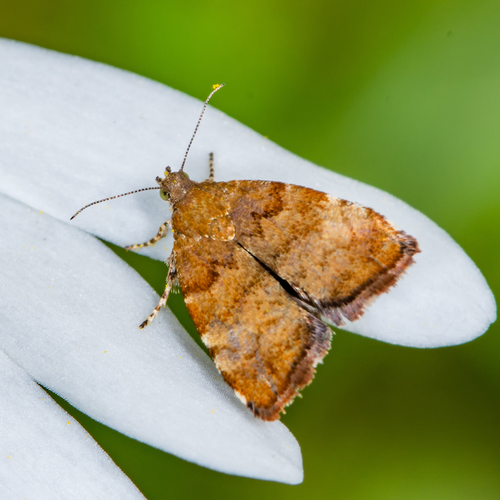
About Choreutis pariana (Clerck, 1759)
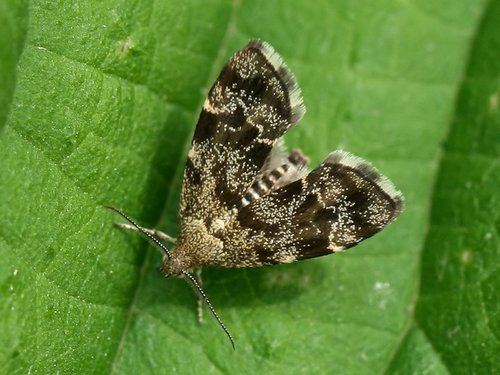
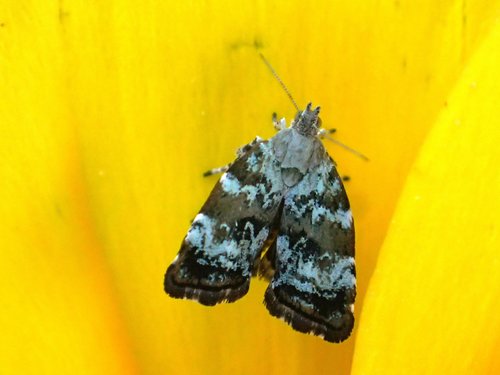
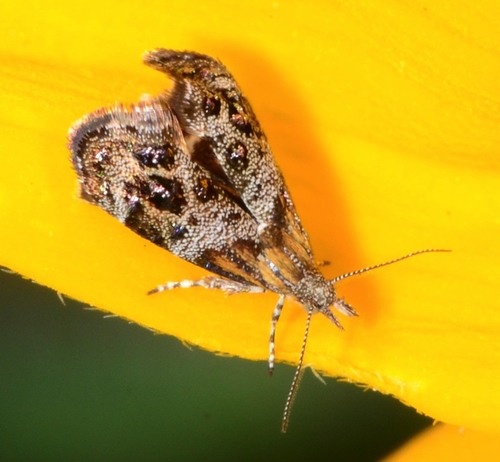
This species is commonly called the apple-and-thorn skeletonizer or apple leaf skeletonizer. Its larvae follow a pattern that is fairly typical for choreutid larvae: they have clearly defined, dark brown pinacula that hold the primary setae (setae present in the first and often second larval instars), plus elongated, narrow prolegs with crochets arranged in a single-ordered circle. Adult moths have a wingspan of approximately 11 to 15 mm. Adult maculation (pattern of wing markings) can be very confusingly similar between Choreutis pariana and its close relatives, so genital examination is often required to tell these species apart. The apple leaf skeletonizer usually has a more brownish overall wing pattern, but its characteristic banding must be carefully checked to confirm identification. This species is native to Asia and Europe, ranging from Japan westward to Ireland. It was introduced to New England in 1917, and is now frequently collected in agricultural areas across North America, where it occurs along the West Coast of the United States, as well as in the Canadian provinces of British Columbia, Ontario, New Brunswick, Nova Scotia, Prince Edward Island, and Newfoundland and Labrador. Larvae usually feed on the upper surface of leaves under a fine silken web. They consume the leaf parenchyma tissue, leaving the lower leaf cuticle intact as a brown blotch on the leaf. This feeding damage creates a skeleton-like appearance for the remaining leaf tissue. Recorded host plants for the larvae include crab apples, hawthorns, paper birches, Betula dahurica, willows, cherries, whitebeams, ashes, roses, and alders. In North America, larvae of this species have been recorded from June to early September. In Britain, larvae are found during May and June, and a second generation occurs in August. Larvae pupate inside a whitish silk cocoon that measures 15 to 20 mm long, and the cocoon is usually attached to the underside of a leaf. In Canada, adult moths have been recorded from late July to late October. In Western Europe, the species produces two generations per year. Adults are on wing in July and again in September; the September generation overwinters as adults, and overwintered moths may become active again in early spring.