About Chordeiles minor (J.R.Forster, 1771)
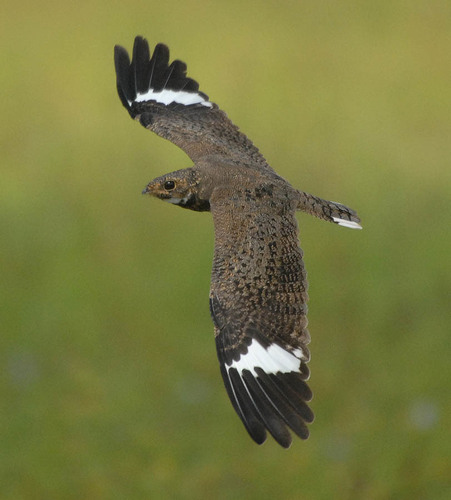
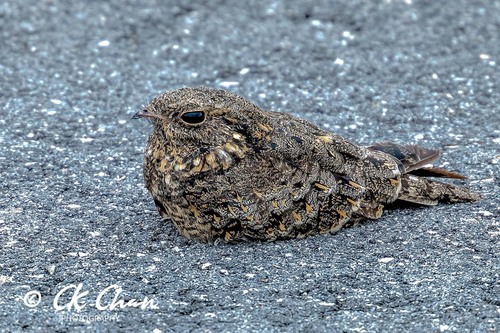
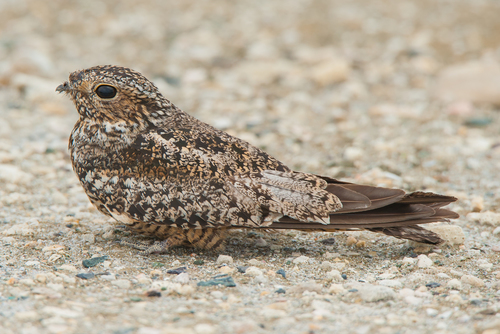
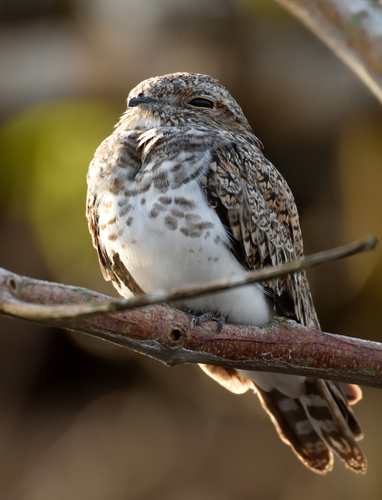
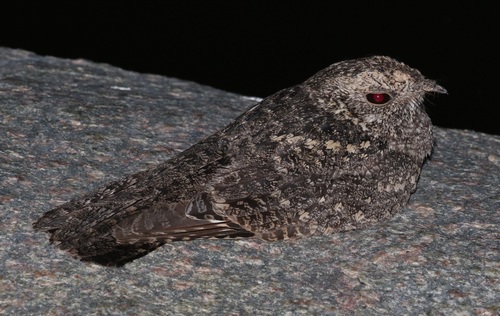
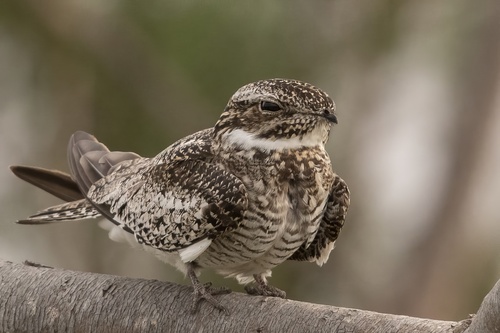
The common nighthawk, Chordeiles minor, can be distinguished from other caprimulgids by several traits: a forked tail that bears a white bar in males, long, unbarred, pointed wings with distinct white patches, an absence of rictal bristles, and a characteristic, unmistakable call that serves as a key identification feature. This species measures 21 to 25 cm (8.3 to 9.8 in) in total length, with a wingspan of 51 to 61 cm (20 to 24 in). Body mass ranges from 55 to 98 g (1.9 to 3.5 oz). Standard measurements are as follows: wing chord 17.2 to 21.3 cm (6.8 to 8.4 in), tail 13 to 15.1 cm (5.1 to 5.9 in), bill 0.5 to 0.8 cm (0.20 to 0.31 in), and tarsus 1.2 to 1.6 cm (0.47 to 0.63 in). The common nighthawk is visually similar to both the Antillean nighthawk and the lesser nighthawk, and it occurs at least seasonally across the entire North American range of both species. The lesser nighthawk is smaller, and has more buff-colored plumage on its undertail coverts, while the common nighthawk has white undertail coverts. Both common and Antillean nighthawks have entirely dark coloring on the basal portion of their primary feathers, whereas lesser nighthawks have bands of buffy spots here. Common and Antillean nighthawks also have a longer outermost primary, which creates a pointier wing tip than that of the lesser nighthawk. The common nighthawk forages at higher heights above ground than the lesser nighthawk and has a different call. The only reliable, non-disturbing way to distinguish the common nighthawk from the Antillean nighthawk is also by call differences. Visually, the two species can only be reliably told apart when examined in the hand, and subtle differences make field identification challenging. The common nighthawk inhabits forests, deserts, savannahs, beaches, desert scrub, cities, and prairies, at elevations from sea level (or below) up to 3,000 m (9,800 ft). Nighthawks prefer to nest in edge and early successional habitats, so they are one of the few bird species that will live and hunt in burned or clearcut forest patches. The common nighthawk is attracted to urban built-up areas by the insects found there. It is the only nighthawk species that occurs across most of northern North America. Food availability is likely a key factor that determines which areas are suitable for habitation and when. The common nighthawk is not well adapted to survive poor conditions, especially low food availability, so a consistent food supply that coincides with warmer temperatures drives its migration and is critical to its survival. It was historically thought that the common nighthawk cannot enter torpor, though recent evidence suggests it does. The common nighthawk breeds from mid-March to early October. It most often produces only one brood per breeding season, though a second brood is sometimes produced. It is assumed to breed every year. There are reports of female common nighthawks reusing nests in subsequent years, and monogamy has recently been confirmed for the species. Courting and mate selection partially occur in flight. Males perform diving displays and produce booms (detailed in the vocalization section) to attract female attention; the female may be either flying or stationary on the ground during this. Copulation occurs after the pair settles together on the ground. During this time, the male rocks his body, wags his fully spread tail, holds his throat bulging, and produces guttural croaking sounds. He repeats this display until copulation occurs. Preferred breeding and nesting habitat includes forested regions with large rocky outcrops, clearings, burned areas, and small patches of sandy gravel. Instead of laying eggs in a constructed nest, common nighthawks lay their eggs directly on bare rock, gravel, or sometimes on a living substrate such as lichen. Agricultural breeding sites are least popular. Since the latter part of the 20th century, urban breeding has been in decline. When urban breeding does occur, it is most often seen on flat gravel rooftops. The common nighthawk is a solitary nester that places large distances between its nest and nests of other common nighthawk pairs, though its nest is more commonly found closer to nests of other bird species. Females choose the nest site and are the primary incubators of the eggs; males will incubate occasionally. Incubation time varies, but is approximately 18 days. The female leaves the nest unattended during the evening to feed. The male roosts in a nearby tree, and he changes his roost spot daily; he guards the nest by diving, hissing, beating his wings, or booming at intruders. When faced with predation, common nighthawks do not easily abandon the nest; instead, they typically rely on their cryptic coloration to camouflage themselves. If they do leave the nest, females have been observed flying away while hissing at the intruder or performing a disturbance display. The common nighthawk is a frequent flyer, with long wings, and hunts while flying for long periods at high altitudes or in open areas. It is crepuscular, and its preferred food source is flying insects. Hunting ends as dusk falls into full night, and resumes again at dawn. Nighttime feeding in complete darkness is rare, even on evenings with a full moon. While the common nighthawk feeds opportunistically, it can adjust its prey choice immediately before capture. Studies show common nighthawks prefer to eat beetles (Coleopterids) and bees, ants, and wasps (Hymenopterids), and will actively seek out these insects in their habitats. Although moths and butterflies (Lepidopterans) are the most common type of insect found in the common nighthawk's diet, the species actively avoids eating flies (Dipterids). Vision is presumed to be the main sense the common nighthawk uses to detect prey; there is no evidence supporting the use of echolocation. Common nighthawks have been observed gathering around artificial light sources to forage for insects that are attracted to the light. The average flight speed of common nighthawks is 23.4 km/h (14.5 mph).