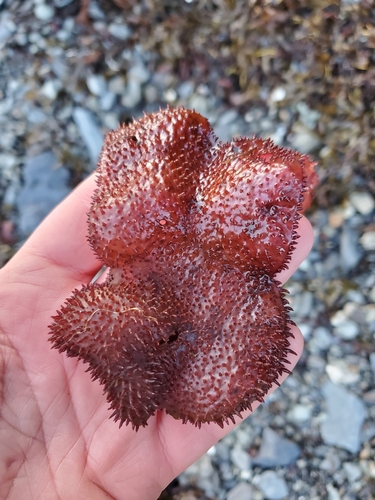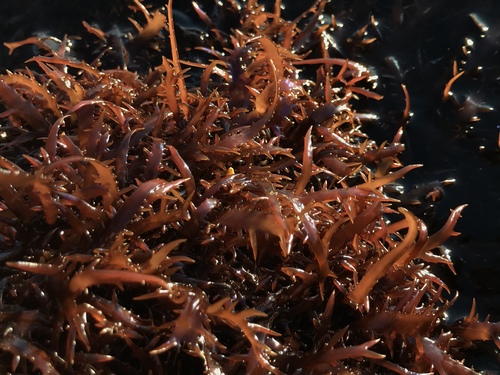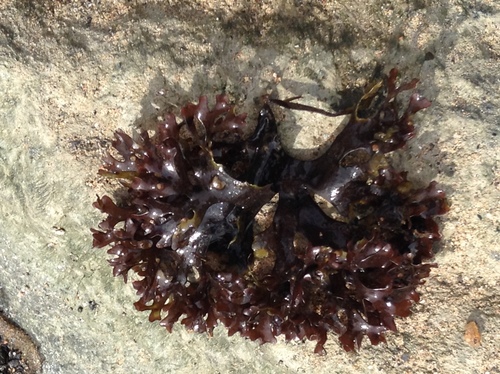
About Chondrus crispus Stackhouse
Chondrus crispus Stackhouse is a relatively small sea alga, growing up to just over 20 centimetres (7+3⁄4 inches) in length. It grows from a discoid holdfast and branches four to five times in a dichotomous, fan-like pattern. Its morphology is highly variable, especially the width of its thalli. Branches measure 2–15 mm broad, have a firm texture, and their color ranges from bright green near the water surface to deep red at greater depths. Gametophytes often display blue iridescence at the tips of their fronds, while fertile sporophytes show a spotty pattern. Mastocarpus stellatus (Stackhouse) Guiry is a similar species that can be easily distinguished by its strongly channelled and often somewhat twisted thalli. Irish moss (another name for this alga) has an alternation of generations lifecycle common to many algae species. It has two distinct main stages: the sexual haploid gametophyte stage and the asexual diploid sporophyte stage. After fertilization, a third stage called the carposporophyte forms on the female gametophyte. Male and female gametophytes produce gametes that fuse to form a diploid carposporophyte, which produces carpospores that develop into sporophytes. The sporophyte then undergoes meiosis to produce haploid tetraspores, which can be male or female and develop into gametophytes. The three stages (male, female, and sporophyte) are hard to tell apart when they are not fertile, though gametophytes often show blue iridescence. This species is commonly found along the shores of Ireland and the coasts of Europe, including Iceland, the Faroe Islands, and the area from the western Baltic Sea to southern Spain. It also occurs on the Atlantic coasts of Canada, and has been recorded from California in the United States to Japan. However, any distribution of this species outside the Northern Atlantic requires verification. Other species of the same genus live in the Pacific Ocean: these include C. ocellatus Holmes, C. nipponicus Yendo, C. yendoi Yamada et Mikami, C. pinnulatus (Harvey) Okamura and C. armatus (Harvey) Yamada et Mikami. Chondrus crispus grows on rock from the middle intertidal zone into the subtidal zone, all the way to the ocean floor. It can survive with minimal sunlight. This species is susceptible to infection by the oomycete Pythium porphyrae. Traditionally, C. crispus is used fresh as a thickening agent in carrageen pudding, a milk-based dish eaten in Scotland and Ireland. It is also an industrial source of carrageenan, which is commonly used as a thickener and stabilizer in milk products such as ice cream and other processed foods. In Europe, it is labeled as E407 or E407a. It may also be used as a thickener in calico printing and paper marbling, and for fining beer. Irish moss is frequently used alongside Mastocarpus stellatus (Gigartina mamillosa), Chondracanthus acicularis (G. acicularis), and other seaweeds that commonly grow together with it. Carrageenan can also be extracted from tropical seaweeds of the genera Kappaphycus and Eucheuma.