About Chondracanthus exasperatus
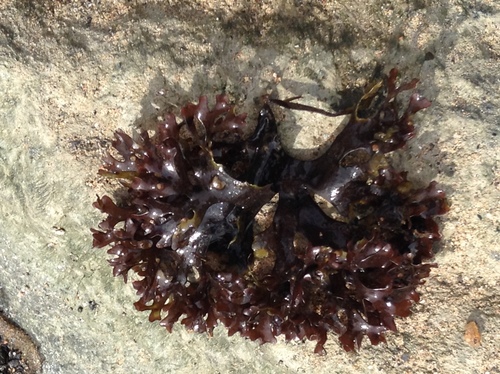
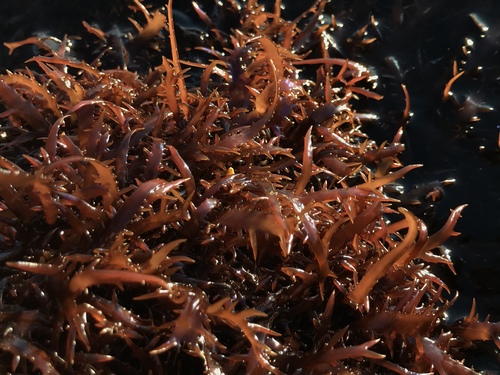
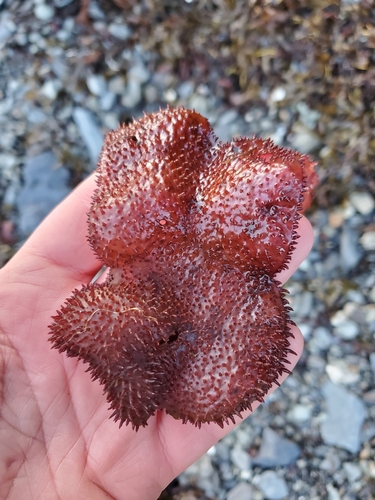
Chondracanthus exasperatus is a perennial red algae species in the Gigartinaceae family. Like many species in this family, its appearance changes based on growing conditions. It can be easily confused with Chondracanthus spinosus and Gigartina binghamiae, and RFLP analysis may be required to confirm its identity. The names of species in the Gigartina and Chondracanthus genera have been revised multiple times since 1961. It is also similar to Mastocarpus species, commonly called Turkish washcloths, but it is smaller and has branched blades. Its blade leaf margins are smooth in cooler water, becoming toothed and jagged as water temperature increases. Blades are thicker in more exposed coastal areas, and higher water velocity also alters blade shape. The thallus is greenish when exposed to ultraviolet light, and darker red to purple when growing in deeper water. While it prefers lower water temperatures, it can grow at 25 °C, though it becomes dark red to black and forms flat or cylindrical branch clusters. As originally described, C. exasperatus has a leafy stipe, with large 0.61–0.91 m (2–3 foot) long, leathery-membranaceous lanceolate simple blades. Most of the thallus, including the blade, is purplish-red. Blade margins are thick, with rounded teeth and appendiculate structures. Simple, ramenta-like spiny projections (papillae) are densely scattered across both sides of the thallus. Coccoid pedicels grow from marginal spines that emerge from the thallus. This species grows fastest in summer, and slowest near the winter solstice. Its thalli have an approximate moisture content of 81.4%, and a protein content of 1.59-1.97%. C. exasperatus is distributed along the Pacific coast of North America, ranging from Baja California north to Sitka Sound. Its type locality is in Puget Sound opposite Fort Nisqually. It grows on rocks in semi-exposed or semi-protected areas from the upper subtidal to lower intertidal zone, reaching depths of up to 20 meters. Proliferation of the invasive species Mazzaella japonica negatively impacts the growth of C. exasperatus. It is also susceptible to infection by the parasitic oomycete Pythium marinum. C. exasperatus decomposes faster than most other seaweed species, which makes it important for detritivores and nutrient cycling. Its rapid decomposition means it is less commonly found washed ashore as wrack, so its ecological importance may be underrepresented in research. Despite this role in detrital food webs, several coastal invertebrates avoid feeding on it: amphipods including Megalorchestia californiana and Traskorchestia species (such as Traskorchestia traskiana), the isopod Ligia pallasii, and the green sea urchin Strongylocentrotus droebachiensis all prefer other seaweed species. When juvenile white abalone (Haliotis sorenseni) are fed a diet of C. exasperatus at extreme water temperatures, their shell growth slows or decreases; the diet can be lethal at 18 °C or above, which raises concerns related to global warming. Commercial aquaculture of C. exasperatus, grown in tanks or on nets, was attempted as early as the 1970s in Washington state. It can also be cultivated in air when sprayed with seawater; this method conserves water, but carries the risk of total crop loss if pumps fail. The gel from its blades has been harvested to make cosmetics. Intact blades are used in baths and for thalassotherapy, alongside other seaweed species including Egregia menziesii (feather boa), Laminaria digitata (finger kelp), and Fucus.